Yesterday evening I witnessed what seemed to me a subtle but egregious act of Holocaust distortion. And it was perpetrated by a genuinely learned Jewish professor at a Holocaust Memorial Day lecture at a London university centre dedicated to studying anti-Semitism.
The distortion was all the worse because it came near the end of an erudite lecture. David Feldman’s subject was on changing British perceptions of the Holocaust from the 1940s onwards. I did not agree with all of his takes but it included what for me were interesting insights.
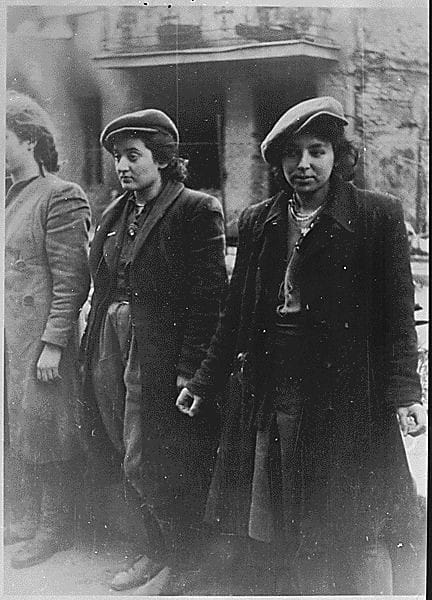
One of these was that the defining act of the Holocaust in the early years of the post-War discussion was the Warsaw ghetto uprising (although the term “Holocaust” was not widely used till the 1970s). That is it was seen as characterised as an act of Jewish resistance albeit one that was ultimately defeated. It was only later, Feldman argued, that Auschwitz came to be seen as the defining centre of the Holocaust. That is the focus shifted almost entirely to the mass murder with little consideration of Jewish resistance. This is perhaps a controversial claim by Feldman but certainly one worth discussing.
The second insight, which seemed to me to be a key one, was that there was no mention of Jewish suffering in the 1957 Treaty of Rome . That is the agreement that established the European Economic Community, which later morphed into the European Union. That is despite the fact that EU leaders nowadays frequently evoke a commitment of “never again” in relation to the Holocaust.
There were many other points made in the speech. But, until near the end, Feldman seemed to me to meticulously follow the convention of academic objectivity. He presented his own views after carefully considering different sides of the argument.
The shift came towards the end when he started discussing Israel’s official perception of the Hamas pogrom of 7 October 2023. That included the claim by some Israeli leaders that Hamas’s actions were in some senses comparable to the Nazis. This was not, it should be noted, the advertised subject of his talk. Yet, after a brief acknowledgement of the Islamist group’s atrocities, he went on to condemn Israel’s actions in Gaza.
Unlike in the rest of his talk this had the characteristic of a political polemic rather than a balanced academic take. There was no attempt to seriously examine Israel’s side of the story. That includes the fact that Hamas and its allies have an annihilationist anti-Semitism, explicitly stated, at the centre of its doctrine. Or that Israel was not just fighting Hamas in Gaza but faced armed assaults from Islamist movements on several fronts including Lebanon, Syria and Yemen. Nor did he take on board the fact that these organisations had extensive state backing including from Iran, Qatar and Turkey.
And even if Israel’s case was rejected there would still be a huge gulf between its actions in Gaza and what happened in the Holocaust. The former was a military campaign which killed a certain number of civilians as well as a substantial number of terrorists (the exact figures are disputed). The latter was a systematic campaign by Nazi Germany, a leading world power at the time, to wipe Jews off the face of the earth.
Of course Feldman is entitled to oppose Israel’s incursion into Gaza. It would also be legitimate for him to counter the Israeli case. But he did not do that. Essentially he just asserted that Israel was doing terrible things in Gaza without considering the counter-arguments.
So a Holocaust Memorial Day lecture on changing British perceptions of the Holocaust somehow morphed into a condemnation of contemporary Israel. No doubt Feldman did not intend to draw a moral equivalence with the Holocaust but it would be easy to draw that conclusion. The implication was that the two events are at least in some senses comparable.
The recording of the meeting should be available soon so readers can judge for themselves whether my criticisms are fair.
The conclusion I draw from this event, and from the contemporary discussion more broadly, is that Holocaust distortion is much more serious than outright denial. Those who deny the Holocaust are thankfully a small and marginal minority. In contrast, Holocaust distortion is rife in sections of academia and the anti-Israel movement.
- Related article. See my review of Pankaj Mishra’s The World After Gaza.
- PHOTO: Public Domain: Women Prisoners During the Destruction of the Warsaw Ghetto, Poland, 1943 (NARA)