Not long ago only those on the fringes of politics would question Israel’s right to exist. Since the 7 October pogrom it has tragically become common. That raises the question of how best to defend it.
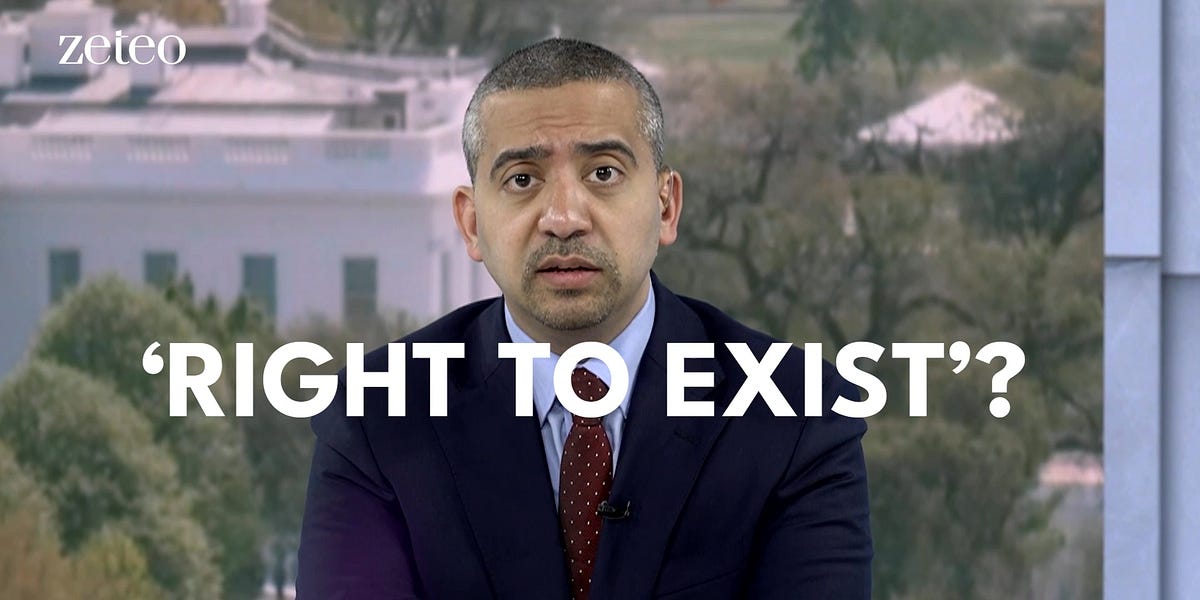
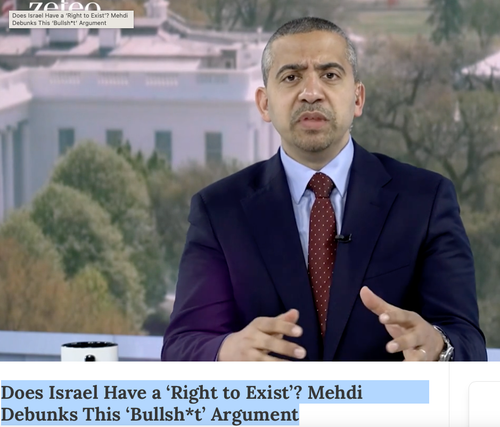
One way to tackle this question is to examine the arguments in a recent video clip by Mehdi Hasan, one of Israel’s most articulate enemies. The word enemy, rather than critic, is used advisedly. He is not interested in balanced criticism of Israel but in destroying the Jewish state.
Hasan raises three counters to what he describes as the “bullsh*t” argument supporting Israel’s right to exist (see video clip below). The middle one is the most important, as that is what his case hinges on, so best to start there.
His central claim is that states do not have a right to exist. Nor do countries. Only individuals, in his view, have rights.
But this ignores the widely recognised argument that rights can be collective. It is entrenched in political thinking and international law – which Hasan often claims to uphold - that there is a right to national self-determination. For example, article one of the United Nations charter states that one of the organisation’s main purposes is to develop friendly international relations based on the “principle of equal rights and self-determination of peoples”.
The principle has also been central in many other contexts including anti-colonial struggles. For example, those who fought for independence in Algeria and Vietnam did so in the name of national self-determination.
Indeed the 1968 charter of the Palestine Liberation Organisation (PLO) talks of the right of Palestinians to “exercise their right to self-determination”. This brings us to Hasan’s third argument “What about Palestine's right to exist?”. Here he is scoring an own goal. If the right to self-determination does not exist even in principle then, by definition, the Palestinians cannot have it either.
The first of Hasan’s arguments also easily falls. He says it is unclear where exactly the borders of Israel should be drawn. Should it, for example, include the West Bank and the Golan Heights. It is of course legitimate to debate the location of borders but that is irrelevant to self-determination as a principle. Hasan’s claim here has no bearing on Israel’s right to exist.
So the arguments in the video clip, although expressed articulately and with vehemence are, to use his term, bullsh*t. They fall at the first hurdle because when properly examined they turn out to be incoherent. His case is a typical attempt at sophistry.
Nevertheless, there are some additional points worth noting on the subject. Mehdi’s cynicism towards the notion of countries having rights is characteristic of the woke animosity towards nation states. It also runs parallel with the world view of Hamas. The Islamist terrorist group does not make its case against Israel in the language of self-determination. On the contrary, for Hamas the elimination of Israel is a necessary pre-condition towards the ultimate goal of creating an international Islamic order. Both progressives, such as Hasan, and Islamists are typically hostile to the notion of national self-determination.
It should also be noted that Hasan is not the only high-profile individual arguing against Israel’s right to exist. For instance, Peter Beinart, a prominent Jewish anti-Zionist figure in America, argued (paywall) against it in the New York Times in January 2025. The thrust of his case is to use violations of the principle of self-determination (for example, instances of America attempting regime change) and alleged misbehaviour by Israel (such as human rights abuses) to discredit the notion of self-determination.
Beinart sweeps aside the importance of self-determination as a principle. His argument is also intended to undermine those who see Israel’s right to self-determination as particularly important to uphold.
The stakes in relation to the conflict over Israel in the West have become even higher since 7 October. It is no longer about what borders Israel can reasonably have. A core principle of Zionism – to support Israel’s right to self-determination – must be defended robustly.
Mehdi Hasan on Zeteo, the new media organisation he founded, denying Israel’s right to exist
 Mehdi Hasan and Team Zeteo