Earlier this month I wrote about a crude but influential anti-Zionist attempt to distort the memory of the Holocaust to discredit Israel. In this article I will examine the more sophisticated work that inspired it.
Norman Finkelstein’s crass The Holocaust Industry argued that America’s discussion of the Holocaust was being manipulated to serve Israeli propaganda. In his view the horrors of the Holocaust were largely ignored in America until the 1967 six-day war in which Israel vanquished its Arab neighbours. After that, with Israel becoming a key strategic asset for America in the Middle East, it became much more prominent.
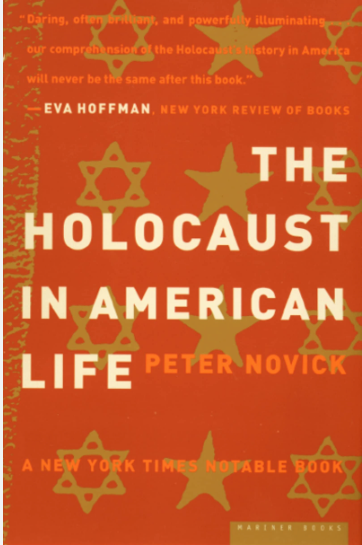
However, by Finkelstein’s own account “the initial stimulus” for his 1999 book “was Peter Novick’s seminal study, The Holocaust in American Life” (p4) (Also called The Holocaust in Collective Memory in some editions). However, Finkelstein criticised Novick’s work on the grounds that it was not “a radical critique” (p5). Finkelstein accused Novick of muckraking because he only focused on the most egregious abuses of Holocaust memory.
This characterisation, as would be expected of as crude a thinker as Finkelstein, is gross self-flattery. His idea of “radical critique” is to take one element of Novick’s argument then stretch it to a ridiculous extent. In contrast, what Finkelstein considers Novick’s “muckraking” is a sophisticated attempt, though ultimately flawed, to explain what could be called the Holocaust paradox. That is the fact that the Holocaust only began to receive scholarly and popular attention as an entity in its own right in the 1960s. The Eichmann trial in Jerusalem in 1961, in which Israel tried one of the architects of the Nazi’s Final Solution, was a watershed. But it was not until the 1970s that Holocaust awareness really took off.
Novick (1934-2012), unlike Finkelstein, was a critical Zionist rather than an anti-Zionist. He was deeply committed to Israel but criticised its settlement policy and advocated swapping land for peace.
Novick, as a professor of history at the University of Chicago, was particularly interested in exploring what he called collective memory (p3). That is to explain how the preoccupations of the present help shape perceptions of the past.
It was in this context that Novick set out to explain the Holocaust paradox. Although its existence is disputed by some it is widely accepted by many historians. He does refer to the alleged Israel connection but in his hands it is a secondary part of the explanation. In Novick’s view Israel promoted Holocaust awareness from 1967 onwards as a way of winning support for the beleaguered state (p268-9).
But for Novick the key driver was an attempt by the influential Jewish community to heal divisions within its ranks. Many young Jews were becoming assimilated in wider society as they lost interest in Judaism. Holocaust consciousness therefore, in Novick’s view, emerged spontaneously as a way of cohering weakening Jewish communal bonds. Paradoxically this happened at a time when anti-Semitism had troughed in America.
This argument has not stood up well to the test of time. If anything Holocaust awareness is higher than ever while the Jewish community is more divided. Many see the Holocaust as providing the ultimate justification for the Jewish state while a minority, particularly among the young, argue Israel has become Nazi-like. In any event the memory of the Holocaust has not united American Jews.
A more fruitful approach would be to look more closely at what Novick identifies as “background condition” in relation to Holocaust consciousness (p8). He points out that the 1970s was a period of emerging moral uncertainty in America. It was at this time of rising social pessimism and the emergence of what became known as “victim culture”. As Novick puts it “There has been a change in the attitude toward victimhood from a status all but universally shunned and despised to one that is often eagerly embraced” (p8).
Under these conditions the Holocaust could be seen as one of the ultimate expressions of both evil and of victimhood. The Nazis of course represented the former and the Jews were the most extreme victims of the latter. As Novick puts it: “The Holocaust was to become an aptly bleak emblem for an age of diminished expectations” (p112).
A broader cultural shift in American society reflected this victim-centred view. For example, it is often pointed out that Holocaust, a 1978 TV mini-series, played a key role in raising popular awareness of the horrors. It is less widely remembered that the show was a response to the immense success of Roots, a 1977 series, which focused on American slavery.
The rising Holocaust awareness in America in the 1970s was part of a trend towards victim culture. That probably also helps explain why there has been a tendency to universalise the Holocaust. That is to see Jews as one set of victims among many rather than examining why Nazis placed such a priority on annihilating them. Indeed the mainstream trend, including among historians, is to vehemently oppose the notion that the Jewish experience of the Holocaust was unique.
The discussion of the Holocaust paradox focuses too much on the actions of Jews and too little on the broader shift to victim culture. In Novick’s case he at least recognises that these wider forces are at work. In relation to Finkelstein he takes one questionable element of Novick’s explanation and stretches it to a absurd degree.
PS – NOTE. Future articles will examine how the discussion of Israel’s alleged settler-colonialism is cynically used to downplay the horrors of the Holocaust.
FURTHER READING. “The World After Gaza: turning the Holocaust against Israel”