Before the Spanish civil war (1936-39) there were few Jews in Spain and no “Jewish question”. Francisco Franco, Spain’s dictator from 1939 to 1975, claimed the Jewish question had been resolved in 1492 when the Jews were expelled by the Catholic monarchs. Yet anti-Semitism was at the centre of Franco’s propaganda campaign during and after the civil war until his death in 1975.
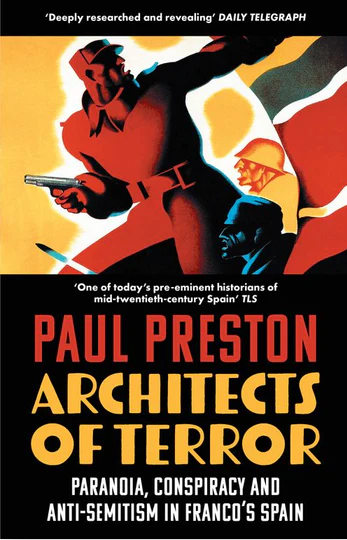
Paul Preston, a historian specialising in the Spanish civil war, is one of the few to focus on the centrality of anti-Semitism to Franco’s coming to power. His Architects of Terror: paranoia, conspiracy and anti-Semitism in Franco’s Spain (William Collins, 2023) illustrates how the Protocols of the Elders of Zion, the notorious anti-Semitic fabrication that claimed to expose an international Jewish conspiracy, was harnessed for malign ends. It was used to justify a war on the Spanish Republic (1931-36) and the murder of over 200,000 Spanish civilians.
The Protocols was first used as a political tool in Tsarist Russia in 1903 as a bulwark against modernising trends and revolution. These threatened to destabilise the traditional order of the church, aristocracy and landowning class. It played a similar role in Spain in 1931 after the Second Republic was voted in and the socialist coalition government began implementing social, political and cultural changes. The reforms, including Spain’s first divorce law, challenged the Catholic church and its traditional values that had a stranglehold on education and morality.
The Protocols inspired a peculiarly Spanish variation of the Jewish conspiracy – el judeo-masónico-bolchevique contubernio which Preston translates as “the filthy Jewish-Masonic-Bolshevik concubinage”. In a similar way to Norman Cohn’s Warrant for genocide: the myth of the Jewish world conspiracy and the Protocols of the Elders of Zion (1967) Preston gives the historical context that helps explain how such an outlandish fiction could galvanise the forces of reaction. It provided a unifying narrative that endured for the entire length of Franco’s dictatorship.
Through short biographies of key personalities Preston describes several eccentrics, reactionaries, larger than life characters and representatives of “Old Spain”. These include Mauricio Carlavilla (a policeman and agent provocateur); Juan Tusquets (a Catalan priest); José María Pemán (a poet) and Gonzalo de Aguilera (an aristorcratic landowner). Also included are Emilio Mola and Gonzalo Queipo de Llano, two notoriously brutal military leaders. According to Preston, all these men were the “theorists of extermination”.
In fact, to describe them as theorists is an exaggeration. They were political propagandists whose interests were threatened by the reforming agenda of the Second Republic. They produced nothing original – their writing and speeches were based on the Protocols, adapted to the Spanish context. But the myth they propagated was used successfully to justify the war on the enemy in the battle of “Spain” against “Anti-Spain”.
Preston shows how Franco sincerely believed in the Jewish-Masonic-Bolshevik triplet independently of Nazi ideology (Hitler was obsessed with it). After the Nazi defeat in 1945 Franco began to publish his own anti-Semitic propaganda under the pseudonym Jakim Boor. In this work, Jews, the freemasons and Bolsheviks were all intertwined but it was the Jews, as set out in the Protocolswho were behind everything. He accused then of creating both freemasonry and Bolshevism. These were cast as part of the overall Jewish plot to overthrow the old traditional order to fulfil their mission to dominate the world.
At the end of the second world war, Franco began to portray himself and his dictatorship as having been sympathetic to Jews fleeing Nazi persecution and the Holocaust. Franco recast himself as the “saviour” of the Jews. Preston dismantles this myth and shows that Franco’s anti-Semitism not only lasted until his death but it also had consequences. For example, Jews were prevented from crossing into Spain as they fled from Vichy France. In addition, some of the Sephardic Jews with Spanish nationality living in places like Salonika were transported to extermination camps when they could have been saved. It was Franco’s policy not to intervene – although a few sympathetic Spanish ambassadors did put themselves at risk to prevent deportations.
Preston wants us to take a lesson from Spain’s history. To give a contemporary twist to the tale, he calls Franco’s Judeo-Masonic-Bolshevik propaganda campaign “fake news”. He warns us that fake news has real consequences. In Spain’s case it contributed to the onset of a civil war. As a warning for the future he shows the anti-Semitic conspiracy is still alive in Spain. In February 2021 a young neo-Nazi, Isabel Peralta, wearing the blue shirt of the Falange(an early 20th century Spanish fascist party) gave a speech at a commemoration rally. She said “The enemy is always going to be the same, albeit with different masks: the Jew".
Preston shows his concern about the persistence of anti-Semitic ideology on the Spanish extreme right but he looks in the wrong direction. Peralta’s extra-parliamentary party has a tiny following of neo-Nazis who cling to theProtocols as factual evidence of a Jewish conspiracy. Yet the Socialist coalition government of Pedro Sanchez, held together by Sumar – the left-wing platform that absorbed Podemos and other leftist parties – uses shrill anti-Zionist rhetoric. It blurs the boundaries between legitimate criticism of Israel and anti-Semitism.
Anti-Zionist/pro-Palestine activism is particularly encouraged by left-wing parliamentarians and local councillors. They frequently use phrases to condemn the “Zionist state” which closely resemble the classic anti-Semitic tropes that come straight out of the Protocols.
In January El País, roughly equivalent to Britain’s Guardian newspaper, published an article with the headline: “Jewish Community in Barcelona manages to take down a pro-Palestine website”. The “pro-Palestine” website was an online platform that aimed to “expose the way the Zionist economy works”. It provided an online map of the “Zionist economy” in Barcelona and Catalonia which included the locations of kosher food shops and a Jewish school for children up to 16-years-old.
Rather than viewing this anti-Zionist activist tool as an anti-Semitic incitement El País unapologetically published the article under its “genocide in Gaza” category (threatened with legal action it later changed the category to “slaughter in Gaza”). In his book, Preston recounted an event in which one of his “theorists of extermination”, Queipo de Llano, gave the local Falange in Seville “free rein to attack and pillage” the small Jewish community’s homes and businesses. Preston’s blind spot does not alert him to where the real dangers of propaganda may lie.
Stefanie Borkum completed her PhD in 2018 and after that vowed never to write anything longer than book reviews.
The views expressed in this article do not necessarily reflect those of the Radicalism of fools project.