One of the intellectual gains among Israel’s supporters in the past couple of years is the improved understanding of the considerable Stalinist influence on anti-Zionism. The Soviet Union and its western supporters shaped the language of contemporary left antipathy to Israel to a remarkable degree. Nevertheless those who highlight this influence typically miss the complete change of context along the way. What counts as left wing in 2026 differs substantially from that in Soviet times.
Indeed there are some parallels with my piece last week on the way Qatari funding has bolstered contemporary anti-Semitism. Although it is a significant part of the story it misses important elements. In both cases the key influence of identity politics, or what some refer to as woke ideas, is missing or at least downplayed in the story.
Izabella Tabarovsky, an expert who was born and brought up in the Soviet Union, has played a key role outlining the Soviet influence on anti-leftist Semitism. Typically it was developed in the form of anti-Zionism or the perception of the Israeli state as a demonic force. This notion includes both the development of the charge that Israel is a settler-colonial state and the supposed equivalence between Israel and Nazi Germany. The Soviet view also had a strong influence on leftist and radical movements throughout the world. For example, Mahmoud Abbas, the current leader of the Palestinian Authority on the West Bank, completed his doctorate in Moscow in the 1980s on the alleged collaboration between the Zionist movement and the Nazis. (For more of Tabarovsky’s work on the Soviet Union’s influence on anti-Zionism and anti-Semitism her articles in the Tablet are a good starting point).
More recently Harvey Klehr, an emeritus professor at Emory university, has had an essay published on Tikvah.org with the title “How the Communist party created Jewish anti-Zionism”. The focus was on how the Communist Party of the USA (CPUSA), following Moscow’s line, promoted anti-Semitic ideas.
One striking example was in the reaction to the massacre by Arab rioters in 1929 of 70 Jews in Hebron and another 18 in Safed. These came after the Arab Mufti of Jerusalem claimed that Jews had desecrated the Temple Mount. Initially Freiheit (Freedom), the Yiddish organ of the American Jewish communists, described the attacks as a pogrom. But the American Communist leadership forced the newspaper to reverse its line. It had to publish a denunciation saying “the war in Palestine is not a race war. It is a class war, carried on by the expropriated Arabian peasants against British imperialism and their Zionist agents.”
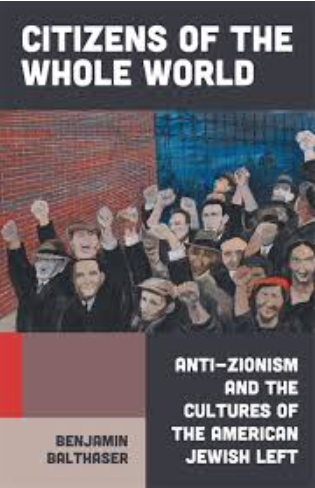
Klehr’s essay is in turn a review of a book by Benjamin Balthaser, an anti-Zionist academic, entitled Citizens of the World Unite: Anti-Zionism and the Cultures of the American Jewish Left (cover pictured above). Although Klehr and Balthaser disagree on much they both accept that the American communist party pursued a strong anti-Zionist line. Only for Balthaser this history is to be celebrated while for Klehr it is to be condemned.
I am with Klehr on the pernicious record of American Stalinism – and I join him in condemning Balthaser for romanticising it – but I think he nevertheless makes a serious error. For Klehr there is a mostly straight line from Karl Marx’s writings on the Jews in the 1840s to the CPUSA to contemporary left anti-Semitism. In my view the differences between these historical periods are as important as the similarities.
Now is not the time to go into Marx’s writings in the 1840s (although I need to get round to doing that). However, there are important differences between leftism today and in the Soviet period. As I argued last week the contemporary left no longer believes in the possibility of a working class transcending social differences. It sees divisions between different ethnic groups and religions as more-or-less fixed. It also believes that there is a hierarchy of oppression with whites, often including Jews, at the top and people of colour at the bottom.
The old Stalinist anti-Semitism was appalling but the contemporary left anti-Zionism is arguably even worse. Stalinists traditionally had little compunction about engaging in the socialism of fools. That is in portraying Jews as rapacious capitalists who sucked the life blood from ordinary people. Contemporary anti-Zionists portray the Jewish state as the epitome of all the evils of western civilisation including colonialism, racism and genocide.
Although many anti-Zionist ideas were developed in the Soviet Union they are applied with super-charged fanatical zeal today. If anything they are the product not so much of the left as of its historic defeat. The original project of the left, in broad terms, was to transform society for the better. The Soviet Union turned out to be a grim model to follow but its collapse increased its despondency still further.
As the left has manifestly failed to reach its objective it has become increasingly pessimistic. That has predisposed it to take an ever-darker view of the world with Jews cast as the ultimate villains.
--------------------------
POSTSCRIPT - There are, as Benjamin Balthaser observes, small ‘tells’, which give some indication of the contemporary Jewish anti-Zionist mindset in particular. For instance, on protests they often wear kippot (skullcaps) and sometimes conduct Jewish rituals such as the Passover seder (ritual meal) in public. This is not something leftist Jewish anti-Zionists would typically have done in the past. More often they would consider themselves as secular people who happened to have a Jewish background. They would generally eschew any characteristically Jewish rituals or items of clothing.
Against the backdrop of identity politics the imagery has changed. Anti-Zionist Jews are keen to emphasise their identity as supposedly good Jews as opposed to the ones cast as evil for supporting Israel. This is a theme I touched on in my recent article on Zack Polanski, the leader of Britain’s Green party.