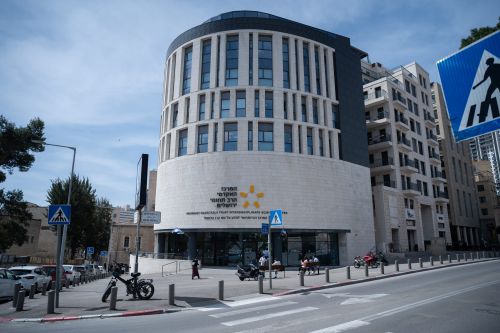
Jerusalem Multidisciplinary College (JMC), a public institution of higher learning specialising in vocational subjects, sits about half way down Jerusalem’s Neviim Street. To the uninitiated that probably just sounds like a straightforward description of the campus location in Israel’s capital. But to those who know the city it points to both to the substantial demand for its services and the extraordinary challenges it faces.
The demand side is more straightforward. JMC (formerly Hadassah Academic College) offers academic but career-oriented degrees in a city of over one million with a particularly youthful population. Among the subjects it offers are biotechnology, computer science, industrial design, laboratory science, optometry, politics, psychology and social work.
Over half of its students are the first in their family to go into higher education. Professor Ariela Gordon-Shaag, JMC’s president, says: “our mission is to make education accessible to people who wouldn’t necessarily be going to college. And they see their degree as a segue to higher economic strata.”
But the population JMC serves is anything but straightforward. The campus is in predominantly Jewish west Jerusalem but within a few minutes’ walk are the main thoroughfares of Arab east Jerusalem. Walk in a slightly different direction and there is Mea Shearim, the central district for the city’s sizeable haredi (ultra-orthodox) population.
The college’s publicly-stated ethos is to serve all sections of the community. That includes Jews and non-Jews, secular and religious. But that is a difficult task.
Perhaps the most obvious divide to outsiders is between Jews and non-Jews. On the Jewish side many of the college’s students and staff have served in the army as conscripts. Some have also served extensive periods as military reservists since the pogrom of 7 October 2023. This has put enormous strains on the individuals doing reserve duty and their families. The college therefore goes to enormous efforts to allow students to continue their education while serving.
It is notable that the school has a memorial to several of its staff and student who fell in the war.
On the Arab-Palestinian side, about 30% of the student body, some have family in Gaza. Nor would it be surprising if at least some of the Arab student body have sympathies with Islamist groups.
But on a day-to-day level the biggest hurdle for Arab students is probably language. Hebrew is the college’s language of instruction but many in east Jerusalem have little or no knowledge of the language. That is because most of those living in east Jerusalem follow the Jordanian Tawjihi curriculum which is taught entirely in Arabic. It also emphasises rote learning as opposed to the active teaching style favoured by JMC. Graduates of such high schools generally have to do 12-month pre-academic courses to learn Hebrew and a bit about Israeli culture. It also teaches them academic strategies to enable them to succeed in the college.
In contrast those Arabs who did their schooling in pre-1967 Israel usually speak Hebrew well enough not to need such programmes. Although such schools teach most subjects in Arabic they include Hebrew as a second language as part of their curriculum.
There are also other pre-academic preparatory courses for those with weak academic backgrounds. Typically this includes haredi men who focus on religious subjects at school so generally learn no English and only basic mathematics. Haredi women are generally better educated in secular subjects. In addition, there are specialist courses for those with learning difficulties and for new immigrants. In each case the goal is to ready new students for the rigours of higher education.
But the complications do not end there. The haredi students, who constitute about 15% of the student population, follow strict rules about what they can eat and contact with the opposite sex. To help them observe these their academic lectures are generally held in a separate building. That in turn is sub-divided into different floors for men and women.
However, when the haredi students do clinical or practical work they must be prepared to work with others. For example, if they are studying optometry they have to go to the main campus and be prepared to treat patients from any background.
There should be no doubt about JMC’s good intentions but it is equally clear it faces formidable obstacles. The divisions within the student body are not of its own making but reflect deeper cleavages in Israeli society. Israeli Jews and Arabs speak different languages and often have strikingly different views of the world. The tensions between haredi Israelis and others are less widely recognised in the outside world but nevertheless run deep. It will take a huge effort to transcend these divisions.
JMC is looking for volunteers to help its students practise their English. This could be online from abroad or in-person in Israel. For more information email international@jmc.ac.il
PHOTO: Gil Volfson.
YouTube video of an interview with Ariela Gordon-Shaag, the president of JMC, on the Rabbi & Other Guy podcast from October 2025.