An article on Israel by Sam Harris, an acclaimed American author, has received praise from many pro-Israel figures but in my view is seriously flawed. He does make some valid points but also some grave errors.
Harris published the article entitled "Why I don't debate critics of Israel" on his substack. It is likely to be widely read because he is a well-known media figure who runs the popular Making Sense podcast.
My criticisms, which I rehearsed on social media, relate to his characterisation of anti-Semitism and his understanding of the enemies of Israel. Those who have come back at me have praised what they see as his moral clarity. I will come back to that point at the end.
1)He is wrong to characterise anti-Zionists as “critics of Israel”. His headline, presumably written by him refers to critics of Israel. Yet I would not call the people he goes on to describe in his first paragraph as critics of Israel: “a growing cast of scholars, grifters, and moral lunatics who have made that beleaguered country their professional or psychiatric obsession.”
There should be no doubt that anti-Zionists are not critics of Israel. They demonise Israel, casting it as the epitome of the world’s evils, while calling for its destruction. In effect, even when they do not fully understand the implications of their arguments, they are endorsing the slaughter of Jews. That emphatically is not criticism.
This is an important point to make precisely because anti-Zionists often cast themselves as critics of Israel. They falsely claim they are just making reasonable criticisms of a deeply flawed country.
On the contrary, and I mean this in a wholly positive way, I would argue Sam Harris is a critic of Israel. He has bravely defended Israel, taking a huge amount of flak for doing so, despite having reservations about its government and its policies. He is a critic in the proper sense of the word while staunchly defending Israel’s right to exist.
2) Harris wrongly frames the conflict in the Middle East as one between Israel and Islam. In fact in a recent podcast discussion with Haviv Retting Gur, one of the most astute Israeli analysts, he explicitly posed the discussion as fundamentally about opposing Jihadism. In his article he also talked about militant Islam being the problem.
This is consistent with his position as a leading new atheist figure. One consequence of this outlook is that he sees organised religion as one of the key drivers of social conflict. Islam in particular, especially in its extremist form, is in his view problematic. His narrow aversion to religion means that he misconstrues the broader drivers of anti-Zionism.
He misses the fact that Islamism is a political movement, albeit one in a religious garb. It is an anti-modern political trend that was born in the 20th century whereas Islam is a religion that emerged in the 7th century. Islamism is opposed to the West but also to mainstream nationalism. Islamist beliefs are presented as ancient but only emerged in modern times.
This is true, for example, of Islamist attitudes towards Jews. It is the case that through history Muslim governments have often discriminated against Jews (in what was known as their dhimmi status). But Islamist movements cast Jews as a source of Satanic evil which must be purged from the world. Islam often endorsed discrimination against Jews whereas Islamism calls for their extermination (For more on the difference between the two see my theme guide on Islamism ).
3) His narrow focus on organised religion also means he neglects to explore seriously the secular drivers of western anti-Zionism. They are driven not by religious fervour but by their estrangement from western values. They loath democracy, economic progress, modernity and tolerance. In addition, they are cynical about the nation state. The reason they have such a visceral hatred of Israel is because they see it as embodying all that they abhor.
This brings us to a question I did not address in my original remarks. That is of the attribution to him of moral clarity.
I am assuming this is a reference to his refusal to draw a moral equivalence between Israel and its enemies. The fundamental goal of Israel is to live in peace in the region while its enemies seek to destroy it.
In this Harris is absolutely correct. There can be no compromise with a force that is dead set on destroying you. There is no equivalence between Israel’s desire for life and its enemies’ desire for it to be destroyed.
Nevertheless, there is a problem with the way that Harris frames the argument. It is true that it is extremely unlikely that a committed anti-Zionist will change their position in light of a rational debate. That should be clear given that anti-Zionists view the Jewish state as the embodiment of the evils of western civilisation.
However, this sidesteps the crucial question of the goal of debating. If there is a reasonable possibility of convincing members of the public it seems to me it is important to debate. It can be worth debating someone with poisonous views, even if they will not shift, if the non-committed can be convinced of Israel’s case.
That leaves the question of why, if Harris’s views are so flawed, they have traction with many sensible people. It seems to me there are two forces at work.
First, the conflict around Israel is often seen in narrow terms. It is often viewed as Israel versus Islamist extremism. The broader forces at work – including Islamism as a political movement and the key role of western self-loathing – are all too often missed.
Second, the understandable defensiveness of many Jews. They are reluctant to debate given the huge amount of hostility they face and the near impossibility of convincing anti-Zionists to change their position. That is particularly in a situation where Jews find themselves politically isolated with few non-Jews willing to stand up for them.
There is only one way out of this impasse. Those who are willing to oppose anti-Semitism and to defend western values should take a stand. That applies to non-Jews as much as to Jews.
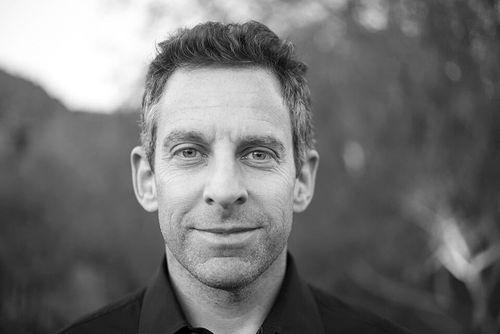
PHOTO: "Sam Harris 2016" by Cmichel67 (Christopher Michel) is licensed under CC BY-SA 4.0.