A key line of attack for anti-Zionists is to debase the memory of the Holocaust. Since Israel’s legitimacy is to a large extent related to the Holocaust they go to great efforts to diminish its importance.
Typically the more sophisticated enemies of Israel are not outright deniers. On the contrary, they acknowledge the Holocaust happened but insist it is comparable to other incidents of mass killing. They also typically insist that Israel is comparable to, if not worse than, Nazi Germany.
One of the main mechanisms for relativising the Holocaust – although it is seldom openly acknowledged as such – is the theory of settler-colonialism. The idea is that Israel in particular is so evil that is pursues what is referred to as a logic of elimination. That is the argument that its whole existence depends on eliminating the Palestinians.
Indeed from this absurd premise it is easy to draw the conclusion that Israel is more evil than the Nazis. After the second world war it was widely accepted that Germany itself could remain intact as long as it underwent a process of denazification. In contrast the prevalent assumption of anti-Zionists, often explicit but sometimes implicit, is that Israel has to be destroyed. The Jewish state, in this warped view, is beyond redemption.
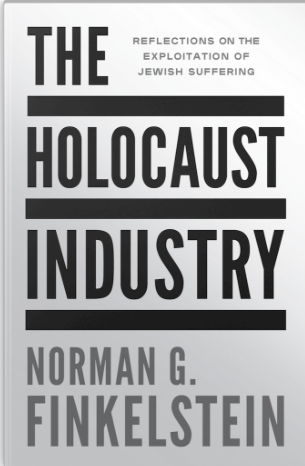
The theory of settler-colonialism will be examined in more detail in future articles. This article will start with what could be consider a popular classic of the counter-Holocaust industry: Norman Finkelstein’s The Holocaust Industry. It is a bestseller, translated into many languages, first published in 2000 and most recently as a second paperback edition published last year. The author, as many readers will know, is a veteran prominent anti-Zionist.
Finkelstein’s thesis is straightforward. In his view Israel together with the wealthy Jewish community are cynically manipulating the Holocaust for their own nefarious ends. He argues that Israel uses the discussion of the Holocaust to bolster its legitimacy. At the same time he identifies several Jewish authorities on the Holocaust who he alleges are simply trying to make money from its terrible legacy.
His anti-Israel argument on the manipulation of the Holocaust is summed up at the start of the book:
“Through its deployment, one of the world’s formidable military powers, with a horrendous human rights record, has cast itself as a “victim” state, and the most successful ethnic group in the United States has likewise acquired victim status.”
The question of whether anyone is cynically manipulating the memory of the Holocaust is at least a legitimate one for investigation. But Finkelstein, the son of Holocaust survivors, is not engaged in serious study. He exhibits a serious case of confirmation bias: grossly exaggerating evidence which supports his argument and ignoring anything that contradicts it. He certainly does not acknowledge, or perhaps even see himself, as part of a movement which itself cynically manipulates Holocaust memory.
Finkelstein’s logical starting point is a reasonable one. He makes a distinction between what he calls “the Nazi holocaust” – that is the actual historical event – and the Holocaust itself. In principle it makes sense to compare what happened in history to the perception of the event at later dates.
He also makes a plausible case that America paid relatively little attention to the Holocaust until after the 1967 Six-Day war in the Middle East. However, his argument goes downhill from there. He claims that until then American Jewish elites ignored the Holocaust because post-war Germany was a vital ally in America’s conflict with the Soviet Union. He also says American Jewish elites wanted to counter leftist Jews from discussing Holocaust remembrance because it was seen as a communist cause.
The first of these claims is ridiculously narrow and the second plain wrong. There were several reasons for the rise of Holocaust remembrance from the 1970s onwards. One of these was a quest for moral certainty in a world which was increasingly seen as uncertain. Focusing on the Holocaust allowed the authorities in the West to argue they were on the side of Good against Evil.
As for the claim about leftists emphasising Holocaust remembrance it is simply untrue. On the contrary, the Stalinist tradition, influential on the left as a whole, was to downplay Jewish victimhood. It was avidly against focusing on the specificity of Jewish suffering.
These are questions which demand more thorough examination than is possible here. For now it is enough to note that Finkelstein’s explanations for the relatively late recognition of the Holocaust are dubious.
Finkelstein then goes on to argue that the standard Holocaust framework is underpinned by what he calls two key dogmas. First, that the Holocaust was a unique historical event. For him this claim is in reality one for unique Jewish entitlement. It is also, as he puts it, “Israel’s prime alibi” (p48). Second, that the Holocaust is seen as the climax of a long history of irrational Jew hatred. To substantiate this he cites Hannah Arendt, a German-Jewish political theorist, for what she called the fallacy of eternal anti-Semitism.
The first of these is a central plank of anti-Zionism. Undermining the notion of Holocaust uniqueness gives extra weight to their case against Israel.
This idea of uniqueness is a broader topic – beyond its relationship to Israel itself – which cannot be resolved here. However, it should be noted that it relates to previous arguments on this site on anti-Semitism as a perception of Jews as representing the evils of modernity. Jews have to be purged from the world, in this malevolent view, if it is to be free of their malign influence.
As for the fallacy of eternal anti-Semitism, Finkelstein is wrong to argue that it necessarily goes together with the idea of Holocaust uniqueness. On the contrary, it is possible to accept the notion of uniqueness while rejecting the idea of eternal anti-Semitism. Finkelstein’s analysis ignores the possibility that the two do not necessarily complement each. Indeed Finkelstein’s confirmation bias is evident here as he ignores the fact that Arendt herself both rejected the fallacy and saw the Holocaust as unique.
From there he compounds his error by arguing that the claim of Holocaust uniqueness is necessarily linked to the idea that it is inexplicable. “Only a flea’s hop separates the claim of Holocaust uniqueness from the claim that the Holocaust cannot be rationally apprehended,” he says (p44). But once again this is not necessarily true. It is possible to uphold the idea of uniqueness while rejecting the claim that it is inexplicable. Finkelstein provides a classic example of someone constructing a crude straw man argument to make his case. Possible objections to his claims are ignored.
Finkelstein shifts gear in the third of the three main chapters of his book. His main focus there is the allegation that the Holocaust industry, particularly the generally pro-Israel World Jewish Council (WJC), extorted money from Swiss banks. Finkelstein attacks the WJC for filing suit against Swiss institutions in 1995 supposedly on behalf of Holocaust survivors. Ostensibly the action was taken to reclaim money deposited in Swiss accounts by Jews before the Holocaust. In reality, Finkelstein claims, the Holocaust industry pocketed much of the proceeds itself. He then argues that the second part of what he calls the “shakedown” involved using the money to provide Zionist-inspired education to Jewish youth.
My main sadness about Finkelstein’s work is that it was endorsed by Raul Hilberg, widely recognised as one of the great Holocaust scholars (1926-2007). Presumably he accepted the kernel of Finkelstein’s argument but it is unfortunate he lent his support to a work that draws such sweeping conclusions.
The Holocaust Industry is a work without any nuance. It takes a plausible argument – that some have cynically manipulated Holocaust memory – and twists it into an extreme anti-Israel and anti-Jewish conspiracy theory. Ironically he does not seem to realise this makes him part of a formidable Holocaust counter-industry.
Having said that it is vital to resist the temptation to use the Holocaust for instrumental ends. The goal of Holocaust studies should not be to support any political position – whether pro or anti-Israel. It should be to come as close as possible to understanding what is arguably the greatest tragedy in human history.
Future articles on the Radicalism of fools will explore this topic further. It is only by grappling with the false claims that it is possible to push back against them.
---------------------------
PS – By Finkelstein’s own account the initial stimulus for his book was Peter Novick’s The Holocaust in American Life (1999 - published for international readers under the title The Holocaust and Collective Memory). Novick’s work is far more sophisticated than Beinart’s but still flawed. I will discuss it in a later article.
Further reading: