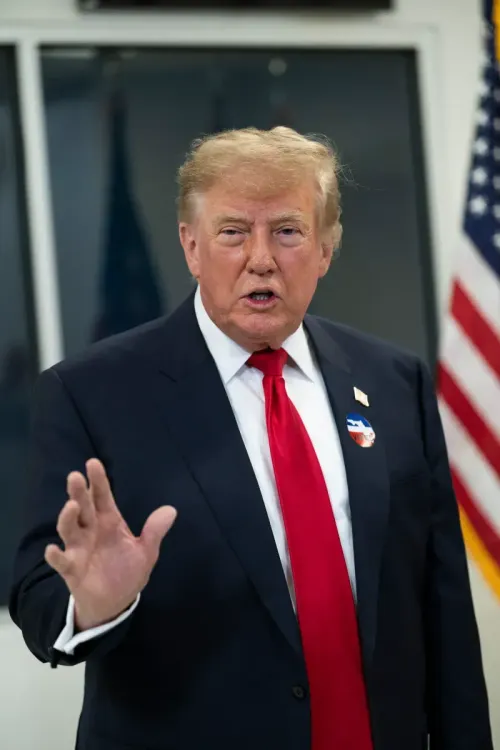
Was Donald Trump’s surprise announcement of his intention to stop American military aid to Israel this year the end of an era?
It could be just one of many idiosyncratic announcements the president has made over the years. Alternatively, it could be part of a broader trend that has emerged in the western world and accelerated since the pogrom of 7 October 2023. Although western leaders expressed their sympathies in the immediate wake of the atrocities their stance has generally shifted against Israel since then. Israel has not quite become a pariah in the West, it still has a significant support base, but it seems to be heading in that direction.
President Trump made his proclamation in an interview with Fox News on the day of the mid-term elections. “We were giving them $4 billion – we are – but it gets cut off at the end of the year.” That is despite the fact that the current 10-year memorandum of understanding on American military aid to Israel runs to 2028.
Trump pointed to the race to become a senator in Michigan, between Abdul El-Sayed and Mike Rogers, as the backdrop to the announcement. In the event, El-Sayed, a Democrat and avid anti-Israel activist, was elected the country’s first Muslim senator.
There was a wide spectrum of reactions to the announcement. In their first response Israeli officials played down the significance of the news. They suggested it was a move towards a more equal strategic relationship between the two countries. Although the officials were caught by surprise, Benjamin Netanyahu had already made statements on this theme. In January, for example, the Israeli prime minister talked about ending American military aid to Israel within 10 years.
However, some independent commentators saw the move as a landmark. Michael Oren, a former Israeli ambassador to Washington DC, called it “the end of an era”. The day after Trump’s shock statement the Israeli expert argued: “Israeli politicians must realize that we are facing a war-like situation that demands national unity.” The fact that Oren, a heavyweight political authority, is making such comments suggests they should be taken seriously.
A prominent anti-Israel expert put his assessment in cruder terms. For Mouin Rabbani, born in the Netherlands to Palestinian parents, Israel was “shitting bricks” over the news.
For those who want to investigate the aid relationship there are detailed reports from America’s Congressional Research Service (CRS) on the topic. The latest, from May 2025, starts by pointing out:
“Israel is the largest cumulative recipient of U.S. foreign assistance since World War II. Successive Administrations, working with Congress, have provided Israel with assistance reflective of robust domestic U.S. support for Israel and its security; shared strategic goals in the Middle East; and historical ties dating from U.S. support for the creation of Israel in 1948. To date, the United States has provided Israel $174 billion (current, or non-inflation-adjusted, dollars) in bilateral assistance and missile defense funding.”
The scale of American support is often used by anti-Israel activists to show Washington’s supposedly unwavering backing for Israel. However, a closer look shows that things are not so simple. As the Wall Street Journal pointed out (paywall) in an editorial on the subject, aid accounted for more than 10% of Israel’s GDP in the 1970s whereas now it is down to about 0.5%. So, relative to the size of the Israeli economy, the importance of American aid has shrunk considerably. It has also fallen in inflation-adjusted terms.
Israel’s supporters also emphasise that American military aid to Israel is overwhelmingly spent on American military equipment and personnel. The money therefore recirculates into the American economy. Israel also gives America privileged access to Israeli technological developments. It is not a simple case of America handing out money to Israel. There are direct benefits on the American side.
Unfortunately, while such caveats are true, they too give an oversimplified portrayal of the situation. The key shift, as already noted in the 2025 CRS report, relates to American public attitudes: “Over the last two decades, including during Israel’s ongoing conflict with Hamas, American public attitudes toward Israel as expressed in public-opinion polling have shifted somewhat when compared to previous eras. Though lawmakers continue to vote in favor of U.S. assistance to Israel, there have been calls from some political and ideological groups to reevaluate the long-standing U.S.-Israeli assistance relationship.”
An April 2026 survey from Pew Research noted that, if anything, American public opinion has shifted further against Israel. It showed that 60% of American adults have an unfavourable view of Israel compared with 53% last year.
That shift in public opinion also seems to explain why American politicians are increasingly turning against Israel. For example, Trump has followed his vice president, JD Vance, in claiming that popular dislike of Israel was one of the main reasons behind the Republicans’ poor performance in the mid-terms.
Of course, this trend should not be exaggerated. Israel still has its friends in America. But the support is more equivocal and cautious than it used to be.
Sadly, Israel is also unpopular across a wide range of countries. A June 2026 survey of 36 countries by Pew found that not only was Israel unpopular in Muslim countries – as would be expected - but in all of the European countries surveyed.
These public perceptions exist alongside growing measures against arms sales to Israel. As the CRS report notes: “Actions to either limit some exports to, or imports from, Israel, have come from countries such as: Britain, Belgium, Canada, Columbia, Germany, Italy, the Netherlands, and Spain. In October 2024, French President Emmanuel Macron called on the international community to cease supplying Israel with weapons that could be used in either Gaza or Lebanon.” Of these, Germany and Italy are substantial suppliers of arms to Israel.
As things stand there has been no suggestion from Trump that America would stop arms sales to Israel. On the contrary, he said America was happy to continue selling arms to Israel and would help the country if needed.
Nevertheless, Trump’s surprise announcement, although apparently not thought through, does suggest Israel is facing a substantial strategic challenge. Not only has it lost significant support from European countries but America too seems more qualified in its support.
The trend could intensify with the electoral success of the Democrats in America. Although most of the elected figures are not anti-Israel ideologues those who are seem to be making headway. And those, such as Abdul El-Sayed in Michigan, are not content with an end to American aid to Israel but are calling for an end to all arms sales.
For Israel pushing back against the international trend means first of all recognising the seriousness of its plight. The international trend against it should not be dismissed or minimised. Israel has to show its customary resilience in tackling external threats.
For Israel’s supporters in the diaspora – whether Jewish or non-Jewish – the task should be clear. Push back against the pernicious influence of anti-Zionism on western public opinion.
PHOTO: www.whitehouse.gov
Further reading: Anti-populism versus Israel