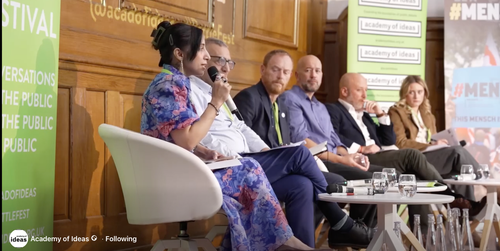
Below are the notes for my introduction for the Islam and Islamism session at last weekend’s Battle of Ideas.
Note that I only had five minutes to outline my argument. This meant that I had to assert key points rather than develop an argument properly. It also meant that I had to leave out illustrative examples.
However, it did have the advantage of forcing me to make the essence of my argument clear. The points could then be developed, at least to some extent, in the subsequent discussion.
Main point: it is vital to distinguish between Islam and Islamism. In particular you need to recognise that IslamISM (emphasising the “ism”) is best seen as a political movement. That is NOT an extreme form of religion but a reactionary form of politics in a religious guise. I’ve only got five minutes so here are five key points.
1)Distinguishing between Islam and Islamism does NOT mean I am romanticising Islam as a religion. There are certainly problems more generally in the Muslim world. But to understand the global Muslim population of about two billion people you have to understand how Islamism operates within it. Many commentators are underestimating and over-simplifying the question.
2)Islamism emerged as a reaction to the moral collapse that followed the first world war. So it is about a century old rather than dating from the seventh century as Islam does. It was the most backward reaction to the early 20th century turmoil: anti-democracy, anti-modernity, anti-freedom, sceptical of the nation-state. In that sense it ran parallel to fascism which emerged at the same time although in a different region. In Europe there was the collapse of the German, Austro-Hungarian and Russian empires. In the Middle East the Ottoman empire fell at about the same time.
3)Although Islamism uses the language of Islam many of the traditions are invented. For example, sharia in the sense it is used by Islamists is a modern invention. The word is only used once in the Koran (to mean a well-trodden path). After that there emerged various schools of Islamic jurisprudence from the classical period onwards. The term sharia as used by the Islamists is essentially their particular conception of a state-enforced system of order.
4) Whatever you think of Islam’s attitude to Jews, Islamism is much worse. Jews in the Muslim world were often discriminated against historically. They were assigned what was called a dhimmi status. In contrast, Islamism sees Jews as a Satanic force which must be purged from the world. Its goal is not to discriminate against Jews but to eliminate them.
5)Islamism can be hard to identify as it often works through covert networks. This can include working as activists within student organisations, Muslim community organisations and Palestine solidarity groups. That means it is difficult to see who the Islamists are. Islamism also claims to be the true expression of Islam and looks down on non-Islamist Muslims.
In the discussion I argued that some of my fellow panellists underestimated the problems we are facing. They failed to see that the problems they see in Islamism are widely shared in sections of non-Muslim society. This topic was explored further in the session on Islamo-leftism the following day.
If I had more time for my introduction I would explain the baleful influence of identity politics in the West. In particular I would have examined how many western governments have promoted Islam as a form of privileged identity. This often takes the form of a state-backed multiculturalism and engagement with self-appointed “community leaders”.