There should no longer be any doubt. B’Tselem, an Israeli human rights organisation lauded by anti-Israel activists, has turned completely anti-Zionist in all but name. It has moved from an organisation documenting alleged human rights violations in the West Bank and Gaza to a political campaign calling for Israel’s destruction.
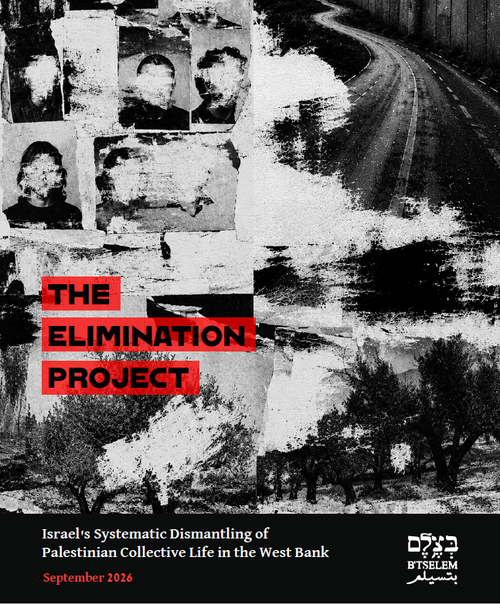
Its anti-Israel political stance should be abundantly clear from its report published last week on what it called The Elimination Project. For the first time its stance on Israel and the Palestinians is framed by the concept of settler colonialism. It defines this as “a project that seeks to establish permanent settler sovereignty over a territory already inhabited by an Indigenous people.” It goes on to argue that Israel: “achieves this by pushing them out, dispossessing them and dismantling their collective existence.”
Although it does not use the words “destruction” or “dismantling” of the Israeli state it is clear from its conclusions that this is what it advocates: “Protecting human rights requires ending the Israeli apartheid regime, not fixing it. Sporadic fixes cannot turn a settler-colonial project based on dispossession into a system that respects human rights. Palestinians' rights can never be guaranteed within a system that works to deny them political power, control their land, and dismantle their ability to exist as a collective. A regime based on Jewish supremacy, apartheid, and dispossession is illegitimate. It cannot be accepted or normalized, nor is it enough merely to reduce some of the violence and dispossession it produces.” This is not criticism of Israel but a demand that it should no longer exist.
Admittedly many allegations are made between the premise and the conclusion. These include restrictions on freedom of movement, association and the press; ethnic cleansing; economic strangulation and territorial takeover. All of these charges are worth investigating – that is what a genuine rights organisation should do – but in B’Tselem’s hands they are almost incidental. Its call to abolish Israel is already embedded in its premises regardless of any evidence.
Take the now common charge that Israel is a settler-colonial state. In the classic model settlers came from and were backed by one of the great powers of the time. Their goal was generally to benefit from the economic resources of the land they were colonising. In relation to Britain that included what became America, Australia, Canada, Kenya, New Zealand, South Africa and Zimbabwe. In relation to France it included Algeria, Morocco and Tunisia.
But the movement to create Israel did not match these criteria. Although the early Zionists did try to get the backing of imperial powers, including the Ottomans and Britain, they were not sponsored by any one country. Indeed Britain, which controlled the area at the time, faced a full-scale anti-colonial revolt by the Zionist movement. From 1944-48 the British needed about 100,000 troops to suppress the uprising at its peak – against a Jewish population of only about 600,000.
Nor were the Zionists motivated by access to economic resources. It is almost invariably forgotten by the anti-Israel movement that large numbers of Jews were fleeing from anti-Semitism in Europe and the Middle East. In most cases they ended up in Israel because they had nowhere else to go. Indeed many survivors of the Holocaust had to stay in former concentration camps after the second world war was over.
But B’Tselem’s take on settler-colonialism is worse than that of those who manipulate the classic model to apply to Israel. By its own account its conception, and the title of its report, was inspired by Patrick Wolfe, an Australia-based historian who died in 2016. The document cites his 2006 article on “Settler colonialism and the elimination of the native” In his account elimination does not necessarily mean physical annihilation but can include assimilation, removal and legal erasure.
For Wolfe what he refers to as settler-colonial invasion “is not an event but a structure”. In other words if a country was founded along colonial lines it remains settler-colonial in character. From that premise he draws the absurd conclusion that America, Australia, New Zealand and others remain as settler-colonial states even in 2026. The implication of his argument is that the only way they can lose that status is being replaced by a completely different type of state. In the case of Israel the lesson drawn is that it cannot continue to exist as a Jewish state. The charge is that as a settler colonial entity it must be guilty of pursuing “the logic of elimination” against the Palestinians.
B’Tselem did not reach such conclusions in one go but has been moving in that direction for the last few years. In January 2021 it released a report entitled “This is apartheid”. Although the allegation has long been discussed in anti-Israel circles this was a big step towards it achieving broader credibility. It came before reports making the same accusation by international human rights organisations such as Human Rights Watch (April 2021) and Amnesty International (February 2022).
The report’s publication marked an important shift for B’Tselem. As the report itself noted: “When B’Tselem was founded in 1989, we limited our mandate to the West Bank (including East Jerusalem) and the Gaza Strip, and refrained from addressing human rights inside the State of Israel established in 1948 or from taking a comprehensive approach to the entire area between the Jordan River and the Mediterranean Sea. Yet the situation has changed.” So B’Tselem was already on its way from addressing Palestinian rights to delegitimising Israel as a whole.
Like similar reports it engaged in a sleight of hand to accuse Israel of apartheid. To the casual observer it gives the impression that Israel closely resembles the former regime in South Africa but read the report more closely and it becomes clear that is not the case: “in public discourse and in international law, apartheid does not mean an exact copy of the former South African regime. No regime will ever be identical. ‘Apartheid’ has long been an independent term, entrenched in international conventions, referring to a regime’s organizing principle: systematically promoting the dominance of one group over another and working to cement it.”
Although this may seem like a reasonable definitional point it is in reality the opposite. As I have previously argued the Israeli case is in a vital sense diametrically opposed to that of South Africa. Apartheid was a discriminatory legal framework to allow the white supremacist regime to use black labour to extract rich resources such as diamonds and gold. Israel’s motivation in holding on to the West Bank is not economic but security-related. It faces an international political movement openly bent on its destruction. Many Israelis in the past were willing to make concessions on the West Bank but more recently, with considerable justification, they fear it could be used as a base to destroy them. After all Israel withdrew from Gaza in 2005 then faced the 7 October pogrom 18 years later. There are certainly grounds to criticise Israel in some instances but these have to be understood in the context of fighting a permanent war against those intent on destroying it.
B’Tselem’s inability to see that Israel is in a war against an enemy intent on destroying it also explains why it has endorsed the false charge of genocide against Israel. This accusation was made in its 2025 report entitled Our Genocide. Yet it conforms to the common pattern of reports on this subject. It fails to grasp that Israel was fighting an existential war in a dense urban environment against a ruthless enemy intent on its destruction. This was a Hamas-led military force which embedded itself among and underneath the civilian population in a vast network of tunnels and other facilities. At the same time Hamas leaders repeated that they would carry the 7 October atrocities out again if they got the chance.
It is of course true that Palestinians suffered enormously as a result of the conflict. But this was the fault of Hamas for starting and perpetuating the war. Israel issued warnings of imminent attacks, even at the risk of casualties on its own forces, and demanded local inhabitants move to safer areas. Such moves no doubt caused huge disorientation among the Palestinian civilian population but Israel’s motivation was to avoid killing them if at all possible.
In fact the new film Naza, held up as a condemnation of Israel, apparently illustrates the opposite of what it intended (I have not had a chance to see it yet). The documentary condemns Israel for making estimates of the likely “collateral damage” – that is deaths of civilians – for any attacks it makes on military targets. But as Natasha Hausdorff, the legal director of UK Lawyers for Israel, has argued this is essential to act as humanely as possible in a war. All western armies are expected to assess the likely impact on civilians of any military action. If the likely casualties are deemed too high steps can be taken to reduce them, for instance by issuing warnings, or the attack can be cancelled. The alternative would be to wage war without any regard to civilian casualties.
War is always a brutal enterprise which tragically entails significant civilian casualties. But Israel is engaged in a war – not just against Hamas but also its allies across the region including the Houthis, Hizballah and Iran – rather than attempting to eliminate the Palestinian population.
But arguably the worst sin of all in B’Tselem’s approach is its reference to “Jewish supremacy”. This might sound like a principled anti-racist stance but it is a way of caricaturing the core Zionist notion of Jewish sovereignty in Israel. In other words, that Israel should be, in an important sense, an expression of Jewish self-determination.
This was an idea that emerged in the 19th century. The idea was that Jews, like other national groups, had the right to a territory of their own. It gained currency among the world’s Jewish communities with the surge in anti-Semitism from the late 19th century onwards. The hope was that if Jews had a state of their own they would be less vulnerable to the intense persecution they were suffering in Europe and the Middle East.
If anything it was the Arab side that was eliminationist from the start. In 1947 the United Nations adopted a partition plan that divided the area that is now controlled by Israel between Jews and Arabs. It was accepted by the Jewish side but not the Arabs. As soon as Israel was founded in May 1948 the surrounding Arab armies, plus that of Iraq, attempted to strangle it at birth.
Neither was it ever intended that only Jews could be Israeli citizens. Israel’s declaration of independence promised equal rights to all citizens regardless of religion. From the start Israel has had a significant non-Jewish minority living within its borders. Their status was not perfect but they enjoyed broadly similar rights to Jewish citizens including the right to vote and sit in the Knesset(parliament). The expansion of Israel in 1967 to include the West Bank and Gaza came as a response to threats to destroy the country. And, as previously discussed, the continuing existential threat against Israel has made Israel wary of making territorial compromises. The event of 7 October if anything increased that wariness.
When B’Tselem rails against “Jewish supremacy” it is essentially arguing against the principle of a Jewish state. That is against the essential character that defines its existence. Similarly its calls for a “future of freedom, justice, equality and democracy for all who live between the Jordan River and the Mediterranean Sea” is an Orwellian use of language. It is using fine words to suggest that Israel should be replaced by an entirely different form of political organisation.
In a parallel universe with a peaceful Middle East it is conceivable that Israelis could opt democratically to live under a fundamentally different political arrangement. But that is a long way from the violent reality of Israel’s region where it faces frequent existential threats. As things stand B’Tselem’s report, despite the fine words, gives tacit support to those who openly state their desire to destroy the only Jewish state.
FURTHER READING