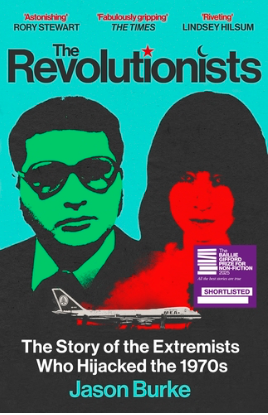
The Revolutionists is a sweeping history of modern terrorism and the competing ideologies that fuelled it. Jason Burke, the international security correspondent of the Guardian, charts the rise and decline of Palestinian nationalist groups, left wing revolutionaries and emerging Islamist organisations. In doing so he reveals how the turbulent politics of the 1970s and 1980s transformed political violence and helped shape the contemporary world.
Burke opens his meticulously researched and compelling account of modern terrorism with the story of the Palestinian “celebrity” terrorist Leila Khaled. In August 1969, Khaled and a fellow member of the Popular Front for the Liberation of Palestine (PFLP) hijacked TWA Flight 840, rebranding it Flight PFLP Free Palestine after diverting the Tel Aviv-bound aircraft to Damascus. Once the passengers and crew had been safely evacuated, Khaled and her accomplice planted explosives on the aircraft, severely damaging the Boeing 707 on the ground. Khaled justified the hijacking as a means of drawing international attention to what she described as “the crimes the Israelis inflict on our people”. She explained that an American aircraft had been deliberately targeted because America was, in her view, an imperialist country that supported Israel. In her view the Palestinian cause was part of a broader struggle against colonialism and oppression. “We are part of the third world and the world revolution”, and she said “greetings to all lovers of the oppressed”.
As Burke explains, the disparate Palestinian factions that united under the umbrella of the Palestine Liberation Organisation (PLO), led by the Egyptian-born Yasser Arafat, were deeply influenced by the revolutionary successes of Maoist China and Fidel Castro’s Cuba, as well as by the anti-colonial struggle waged by the Algerian National Liberation Front (FLN). These movements provided both an ideological framework and a practical model for armed struggle, helping to shape the PLO’s political outlook and strategy in its formative years.
Left wing terrorist groups drew upon the writings of Régis Debray, a French intellectual, who had fought alongside Che Guevara in Latin America. They embraced a conception of revolution that departed from orthodox Marxism. Traditional Marxist theory held that capitalism would be overthrown by a politically conscious working class led by a disciplined communist party. In contrast, Debray maintained that a small, committed cadre of armed revolutionaries could itself act as the catalyst for wider social and political upheaval. In this view, the foco, or guerrilla vanguard, would not merely advance a revolution but create the very conditions in which one could emerge. Armed struggle was therefore seen not as the culmination of revolutionary change, but as the means by which it could be brought into being.
The left’s evolving worldview was further shaped by Israel’s decisive victory in the Six-Day War of June 1967. The conflict marked a decisive turning point in left-wing attitudes towards Israel. Increasingly, sections of the western left came to view the state not as a pioneering socialist experiment, exemplified by the kibbutz movement, but as a bastion of western power and imperial influence in the Middle East. During this period, the term “Zionism” acquired sharply negative connotations among many left-wing activists and intellectuals. It became associated with colonialism, racism, and imperial domination. This ideological shift helped lay the foundations for the growing solidarity between western radical movements and Palestinian nationalist organisations during the late 1960s and 1970s.
At the same time, many western leftists had become deeply disillusioned with the apparent complacency of the post-war working class. The left drew the conclusion that the public was “more interested in foreign holidays and saving up for fridges ... than manning the barricades”. Convinced that the revolutionary potential predicted by Marx had shifted from the industrialised West to the developing world, they looked instead to anti-colonial struggles in the third world. For some, this commitment went beyond intellectual solidarity, as thousands of young western radicals travelled to Jordan to receive guerrilla training in Fatah-run camps. Despite their shared revolutionary ambitions, they often proved an awkward fit with their Arab hosts, whose social norms and cultural expectations differed markedly from those of their western comrades. Tension became apparent when the three founders of the West German far-left terrorist group, the Red Army Faction, Andreas Baader, Gudrun Ensslin and Ulrike Meinhof attended a Fatah training camp in Jordan. Baader reportedly insisted on completing the assault course while wearing tight velvet trousers. Meanwhile, Ensslin and Meinhof scandalised their socially conservative fedayeen (guerilla fighters) hosts by sunbathing nude.
During the early 1970s, international terrorist groups often seemed able to carry out spectacular acts of violence with little fear of legal consequence. Following her failed attempt to hijack an El Al flight from Amsterdam to New York, during which an Israeli crew member was seriously wounded, Leila Khaled was arrested at Heathrow Airport. Yet the British authorities released her within weeks in exchange for the freeing of prisoners held hostage by the PFLP in Jordan. As Burke dryly notes, “commandeering a passenger aircraft did not appear to be a crime in the UK”. The incident highlights how ill-equipped western governments were to confront the new wave of transnational terrorism that emerged during the period.
By the mid-to-late 1970s, however, the tide was turning. Governments that had initially appeared ill-equipped to deal with international terrorism were adapting to the challenge, tightening security and closing legal loopholes. They refused to negotiate with hostage-takers and increasingly took the fight to the terrorists themselves.
Among the most compelling examples of this fightback is Burke’s account of Operation Thunderbolt, the daring Israeli mission to rescue the hostages held at Entebbe airport in Uganda. The operation demonstrated that states were no longer prepared to concede the initiative to international terrorists. The crisis began on 27 June 1976, when Air France Flight 139, travelling from Tel Aviv to Paris via Athens, was hijacked by members of the PFLP and German militants from the Revolutionary Cells. After the aircraft was diverted to President Amin’s Uganda, the hijackers separated the Jewish and Israeli passengers from the other hostages and threatened to kill them unless 53 imprisoned militants, most of them held in Israel, were released. For many of the Holocaust survivors on board the aircraft the ordeal revived “appalling memories” as Germans armed with assault rifles stood guard over Jewish hostages. Flying more than 2,500 miles to Entebbe Airport, an elite Israeli force successfully freed 102 hostages in a raid. The mission showed Israel’s determination to protect its citizens from international terrorism. As Burke observes, the successful raid on Entebbe was “seen as the crowning achievement of the strategy Israel’s security forces and army had adopted since the killings at the Munich Olympics” in 1972.
By the late 1970s, the revolutionary left’s campaign of armed struggle against what it saw as western imperialism was beginning to lose momentum. The promise that small groups of committed militants could ignite a broader revolution had failed to materialise. It became increasingly clear that terrorism would not bring about the collapse of capitalism. As Burke points out, the revolutionary left suffered not only operational setbacks but also a profound ideological defeat. Other political ideas such as the growing Green movement began to capture the interest of German youth.
The decline of the radical left is vividly illustrated through Burke’s account of the degeneration of Ilich Ramírez Sánchez, better known as Carlos the Jackal. Having begun his career as a self-styled international revolutionary committed to the Palestinian cause and the global struggle against capitalism, by the 1980s he had become little more than a mercenary operative. He worked on behalf of a dwindling group of Eastern European and Middle Eastern regimes willing to sponsor acts of political violence. His transformation from revolutionary icon to hired gun mirrored the broader fate of the militant left itself. Its grand ambitions of world revolution had given way to ideological exhaustion, state patronage and political irrelevance.
The politics of the Middle East were also changing. In June 1982, the Israeli military laid siege to Yasser Arafat’s PLO headquarters in Beirut, eventually forcing the organisation into a negotiated withdrawal from Lebanon. Arafat had made Beirut the PLO’s main base after fleeing Jordan in the aftermath of Black September in 1970-71, when King Hussein crushed the Palestinian guerrilla movement and expelled its leadership from the country. The fall of the PLO’s Beirut stronghold marked a turning point. For the Palestinian nationalist movement, it was the beginning of a new phase in the conflict: the transition from armed struggle to political negotiation. That process ultimately culminated in the Oslo Accords of the early 1990s, through which Israel and the PLO formally recognised one another.
In the vacuum left by the PLO, Islamist movements inspired by the 1979 Iranian revolution began to gain influence across the Middle East. Unlike the left-wing nationalist groups that had dominated the Palestinian cause since the mid-1960s, these organisations reframed the struggle through an explicitly Islamic lens. While retaining elements of anti-imperialist and anti-Zionist rhetoric, they replaced secular nationalism and Marxism with a distinct Islamist ideology.
Burke illustrates this ideological shift through the career of Abdallah Azzam, a Palestinian scholar and Muslim Brotherhood member. Having visited a PLO training camp in Jordan in the early 1970s, Azzam recalled that he “was disgusted by the sight of [western] women beguiled in the name of Palestine”. In later writings, he gave expression to an increasingly Islamist outlook that, Burke notes, also drew upon themes found in Nazi propaganda. Azzam went on to claim that the Russian revolution was “Jewish in ideology, planning, funding and execution”. He argued that since 1917 “all communist revolutions in the world are Jewish”. Against this perceived threat, he proposed jihad as the remedy. He insisted that it would “ignite the energy of the ummah and return Islam to its rightful power and glory”. In his vision, “only through violence would come renewal”.
As Burke shows, this represented a profound departure from the revolutionary ideas of the 1960s and 1970s. The language of class struggle, national liberation and third world revolution was increasingly supplanted by a religiously framed struggle. The Islamists viewed political violence not merely as a means of achieving national objectives but as a sacred duty in defence of the Islamic community.
The tactics employed by terrorist groups were also changing to reflect the shift towards Islamism. Increasingly, organisations such as Palestinian Islamic Jihad turned to the use of shahids, or “martyrs”, deploying suicide bombings with devastating effect. Burke vividly describes how these attacks transformed the nature of terrorism. They enabled relatively small groups to inflict unprecedented casualties while exerting a powerful psychological impact far beyond the immediate victims. He recounts how suicide bombers were used against the Israeli military, as well as French and American military and diplomatic personnel in Lebanon during the early 1980s. In contrast to the hijackings and hostage-taking operations that had characterised the previous decade, suicide bombings offered militants a potent new weapon. They were difficult to prevent and capable of generating immense political and symbolic resonance. This tactical innovation would prove to be one of the most consequential legacies of the emerging Islamist movements.
The Revolutionists is much more than a history of terrorism. It is a history of the ideas that inspired men and women to embrace political violence in pursuit of revolutionary change. By charting the ideological journey from Palestinian nationalism and left wing revolutionaries to the rise of Islamism, Burke shows how one era of terrorism gave way to another while leaving a lasting imprint on the modern world. The one weakness of this excellent book is that he could have said more about the extent to which anti-Zionism and anti-Semitism influenced elements of the PLO, their far-left allies and later, Islamist organisations in their struggle against Israel. Even so, Burke has produced a richly detailed, thought-provoking and highly relevant account of a turbulent period whose legacy continues to shape the world today.
Simon McKeon is an archivist based in London.
Jason Burke. The Revolutionists: The Story of the Extremists Who Hijacked the 1970s (Penguin 2025)
The views expressed in this article do not necessarily reflect those of the Radicalism of fools project.