The many critics of my recent articles which argued that Islamism is best seen as a form of religionised politics have followed a similar pattern. They accuse me of having insufficient knowledge of Islamic texts and a failure to appreciate the importance of the lack of an Islamic Reformation. All have focused on trying to emphasise Islamic extremism. In contrast, none have tried to critique my argument that Islamism is essentially a political movement despite its extensive use of Islamic language.
This failure to consider whether Islamism is best seen as form of politics is hardly surprising. Although there are experts who make this case, notably including Olivier Roy and Bassam Tibi, it is not often put to the public.
Here I want to sketch my take on the subject. I will explain why Islamism is best seen as emerging in the aftermath of the first world war. In addition, I want to show there is a rough inverse correlation between radical nationalism and Islamism. In other words, Islamism tends to become stronger as nationalism becomes weaker. Sometimes there is a blurring of the lines between the two but in general terms that is how the relationship works.
I should emphasise that what follows is a hypothesis. There are plenty of gaps to fill. But since I have not come across anyone else laying out these arguments systematically I have decided to sketch them myself.
1) Revolution and reaction after the first world war
The starting point for my argument is to understand the general significance of the period after the first world war. It was a time when the old order collapsed and a new order started to take its place. My argument on the lasting importance of the first world war is influenced by Frank Furedi’s The First World War: Still no end in sight. However, I should add the disclaimer that I have no idea whether he would accept the arguments I am outlining here.
There were several related developments at this time which are relevant to our story:
*The collapse of four empires that until that point had played a key role over much of the earth’s surface: the Austro-Hungarian, German, Ottoman and Russian empires.
*The Russian revolution of 1917 which in turn sparked a series of radical movements and attempted revolution worldwide.
*A reaction against the revolutionary upsurge from forces opposed to modernity and democracy. It was in the aftermath of the first world war that fascism emerged in Italy and the Nazi party started in Germany. Also, by the mid 1920s, a Stalinist reaction within the Soviet Union had emerged. This movement was opposed to the revolutionary ideals professed by the Russian revolution and soon became a totalitarian force.
2) The Middle East situation
These general developments in the post first world war took a particular form in the Middle East.
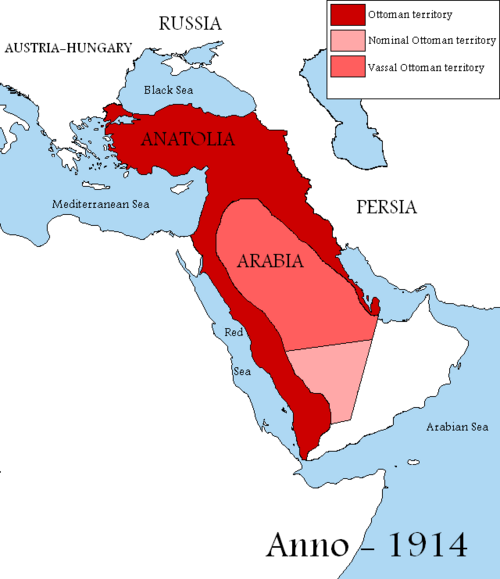
*The collapse of the Ottoman empire, based in what is now Turkey, which had lasted for hundreds of years (although its geographical coverage peaked in the 17thcentury, see map below). Over time the leaders of this empire claimed to be the caliphs of Islam, responsible for Islamic stewardship of the region. The collapse of the Ottoman empire, with the region being occupied by Britain and France, was seen as an immense humiliation.
*The Balfour declaration of 1917, in which the British gave support to a Jewish homeland in Palestine, was viewed as compounding the humiliation. Indeed this coincidence helps explain how a genocidal anti-Semitism became central to Islamism as well as having a broader influence in the region.
*The Ottoman empire’s replacement by an avowedly secular Turkish regime cannot be compared in impact to the Russian revolution but was nevertheless a great upheaval. By 1923, after a bloody war of independence, the Turkish republic was declared under Mustafa Kemal Atatürk. By the following year the caliphate was completely abolished. The Kemalist revolt also had an impact on other countries in the region including Egypt. In Turkey itself it was not until the late 20th century that Islamists began to be elected into office.
*In Egypt, the most populous Arab country and the centre of the Arab world, there was also a radical upsurge. In 1919 there was a radical nationalist revolution against the British occupation. Egypt was granted formal independence by 1922 although Britain retained considerable influence, particularly over the Suez canal zone.
*This was the context in which the Muslim Brotherhood (al-Ikhwān al-Muslimūn), widely recognised as the first Islamist political movement, was formed by Hassan al-Banna (1906-1949) in 1928. It was opposed both to the West but also to the radical nationalism that had emerged in Egypt at the time. (For more details the story of the early years of the Muslim Brotherhood is recounted in Richard P Mitchell The Society of the Muslim Brothers (Oxford 1993). In other words, it was a movement, often prone to violence, which was resolutely opposed to western civilisation, modernity and democracy. Its ultimate goal was the creation of an international Islamic order. Since its founding the Muslim Brotherhood has spread its influence through its networks all over the world.
In important respects the emergence of Islamism runs parallel to the development of fascism in the West. Both are prone to using violence while being opposed to modernity and democracy. However, in my view it is misleading to describe it as “Islamo-fascism” as the context in which it emerged was substantially different from that in Europe.
[The first Islamist movement in the Indian sub-continent was Jamaat-e-Islami founded in Lahore, British-occupied India, by Abul Ala Mawdudi (1903-1979) in 1941. Although this was no doubt an important part of the story it is not something I have looked into so I will not comment on it further here.]
3) Developments over a century
Since 1928 Islamist groups have spread geographically and gained further influence. In particular it is clear that the movement has gained from the discrediting of radical nationalist movements.
*1967. The Arab-Israeli Six-Day War. This conflict, in which Israel militarily defeated its Arab neighbours in less than a week, was a huge blow to pan-Arabism. That was the belief that all the Arab peoples could ultimately become united under one nation state. Islamists at the time explained the defeat by arguing that it was because Arabs had lost their ideological bearings. Although the defeat did not lead to an immediate Islamist upsurge it paved the way for it to gain ground later on.
*1979. The Iranian revolution. The 1979 Iranian revolution was a huge fillip to the Islamist movement with it capturing control of one of the most important Middle Eastern states. Although Islamism in Iran takes a Shiite form there are many crossovers with the Sunni versions of Islamism. For example, Ali Khamenei, once the supreme leader of Iran, translated four books by Sayyid Qutb, the leading Islamist ideologue who was Egyptian, into Persian.
*The end of the Cold War in the late 1980s and early 1990s. The end of the Cold War discredited nationalist movements, many of which had links to the defunct Soviet Union, and bolstered Islamist groups. Hamas, which defines itself in its 1988 covenant as an arm of the Muslim Brotherhood, provides a prime example. It was only founded in 1987 yet within two decades or so it had become a leading force among Palestinians. In parallel with that the Palestine Liberation Organisation, the nationalist movement founded in the 1960s, has gone into precipitous decline. But that is only one example. There are numerous Islamist movements spread throughout the world including Africa, America, Asia and Europe.
4) The spread of Islamism in the West
The final part of the story so far is the spread of Islamism to the West and its interaction with identity politics. Muslim migration to western countries has brought with it significant numbers of migrants from poorer nations. Of course only a minority of these are associated with Islamist groups. But there are Islamist networks, generally operating covertly, with links going back to many countries including the Arab world, the Indian sub-continent, Iran and Turkey. This has intersected with a growing group of Muslims born and brought up in the West who have taken on an Islamist identity.
In this context it should be remembered that identity politics in general has come to be a significant force in the West. That is among the indigenous white population as well as the second, third and fourth generation descendants of migrants. In these circumstances the migrant descendants often take on an Islamist political identity. This is particularly the case as western elites often favour Islam as they see it as an oppressed identity. The question of Islamism and Muslim identity in the West is examined further by Olivier Roy, a leading French expert, in his Globalised Islam.
Although Islamism claims to be the authentic voice of Islam it is better seen as a political movement. It may use Islamic vocabulary but it is a political movement shaped by developments since the early 20th century.
For further articles on Islamism click HERE
The Ottoman Empire at its geographical peak
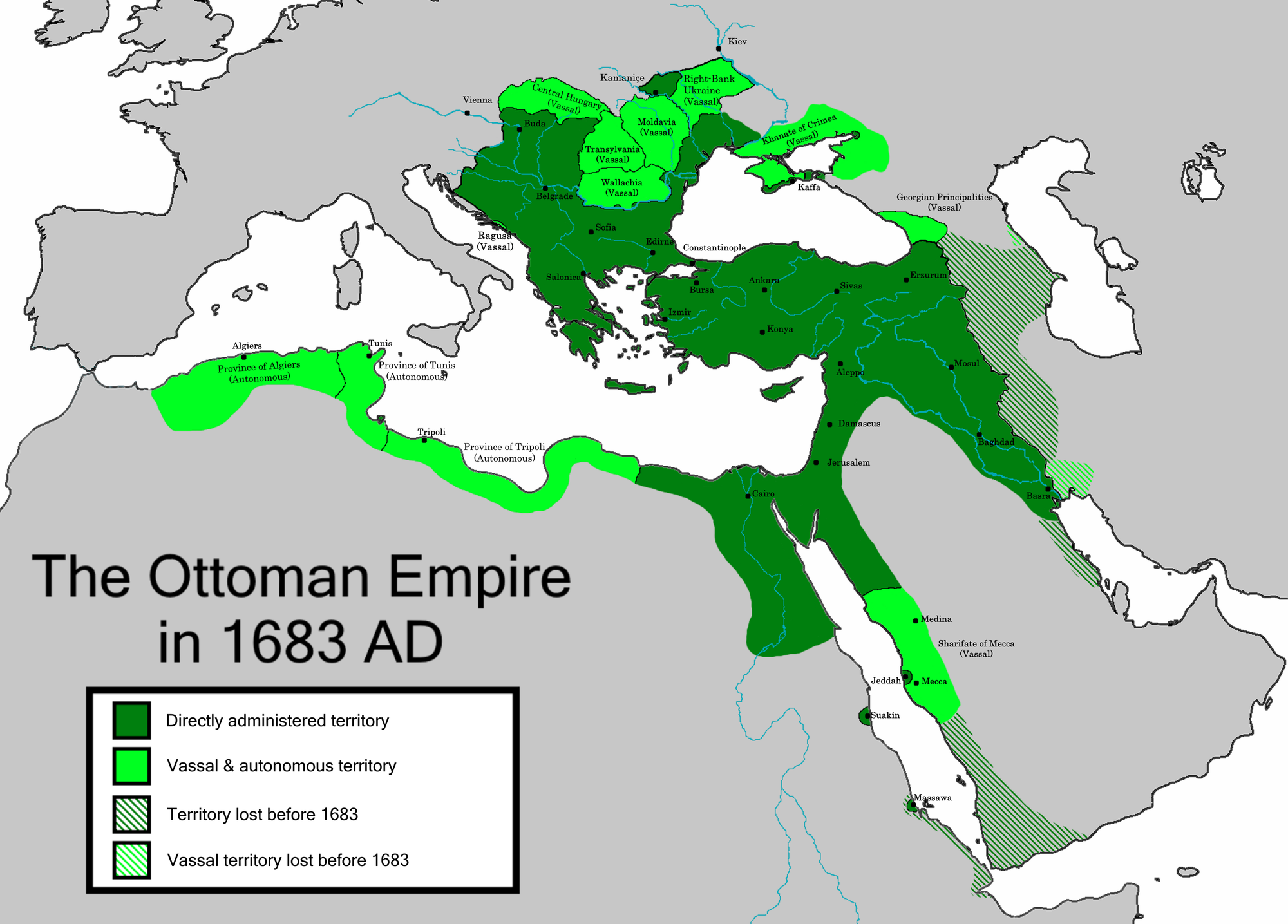
Source: Chamboz at English Wikipedia, CC BY-SA 4.0, https://commons.wikimedia.org/w/index.php?curid=89899000