Ahmed Fouad Alkhatib is a rarity. A man of Palestinian origin who is willing to openly condemn Hamas. That is despite the Israel Defense Forces killing dozens of his family members during the recent war in the Gaza strip.
Unsurprisingly, he is a critic of Israel but in the proper meaning of the word. He is emphatically not a ‘critic’ in the sense the term is often used by anti-Zionists: demonising Israel and calling for its destruction. On the contrary, he supports Israel’s right to exist and unequivocally condemns the 7 October pogrom. But he does argue that Israel’s invasion following the atrocities was a gross over-reaction.
In any case, he has gained a reputation since 7 October as a balanced commentator on Palestinian affairs. From his American base, where he is founder and director of the Realign for Palestine project (It is possible to subscribe to its newsletter here). The project operates under the umbrella of the Atlantic Council, a think tank based in Washington DC, where Alkhatib is a resident senior fellow of its Middle East programme. At times both Israelis and Palestinians vehemently disagree with his takes but he is nevertheless widely respected.
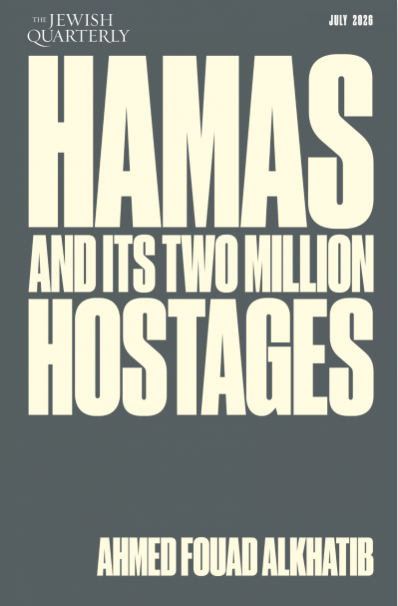
His essay on “Hamas and its Two Million Hostages” in the special edition of Jewish Quarterly (where you can order the article) is a succinct summary of his arguments. For those unfamiliar with what life for Gaza Palestinians has been like over the years it is a valuable primer. For those who have tried to follow the subject over the years it provides a useful reminder of some of the key developments.
Although the essay is not autobiographical it broadly follows the contours of Alkhatib’s life. He was born in 1990 in Saudi Arabia where his father, whose family came from Gaza, was working as a medical doctor for the UN. The family vacationed in Gaza every summer and spent two years there in the late 1990s. Then in 2000 it returned permanently.
In 2005, at the age of 15, he left Gaza for what was supposed to be a one-year cultural exchange programme in America. But as it turned out, because of conflict between Israel and Hamas, he has not been able to return to Gaza since. He was granted political asylum in 2007, after the Hamas takeover of Gaza, then became an American citizen in 2014. Despite not having returned to the strip he maintains close family and other contacts with the area.
One of Alkhatib’s most important contributions is a reminder that Hamas is a relatively recent force in the Gaza strip. The organisation was only founded in 1987, at the start of the first intifada (uprising), although it did have precursor organisations before that. Although Gaza was long a devout Muslim area, including Alkhatib’s family, the Palestine Liberation Organisation (PLO) was in the ascendant during his early life. Alkhatib argues that a combination of factors made the rise of Hamas possible. These included: “successive failures and tragedies that were made possible by poor Arab leadership, Egyptian interference, foreign ideologues and a diversity of political players who oscillated between secular nationalism, communism, and in the case of Hamas, Jihadi Islamism”. He also argues that Hamas bribed itself to relevance through extensive charitable and welfare activities. That was before it openly took up political action and militancy.
Hamas won the Palestinian legislative council elections in Gaza in January 2006, a few months after Israel withdrew from the territory (although the Islamist group won a majority of the seats but not the popular vote). Hamas stood on an anti-corruption ticket rather than focusing on armed resistance against Israel. Shortly afterwards Hamas violently purged its nationalist opponents of the PLO. There have not been any elections in the territory since.
Alkhatib also argues that the international humanitarian assistance given to Gaza had the unintended consequence of allowing Hamas to rule the territory for almost two decades. The Islamists could concentrate on building up its military infrastructure while foreign aid maintained the civilian population. Hamas also often skimmed money from aid into its own coffers.
In this context it should be remembered that Israel also played a role in maintaining Hamas in power although not out of any affinity for the Islamist group. From 2018 the Netanyahu government allowed Qatar to funnel tens of millions of dollars a month into the territory in a bid to keep the regime stable. Although Israel’s goal was to stop the strip from collapsing it was an approach which, with the benefit of hindsight, clearly backfired.
Alkhatib goes on to attribute the 7 October pogrom to several factors. First, Hamas was coming under financial pressure as Qatar was considering cutting its funding. The oil-rich sheikhdom was becoming tired of the terrorist group. Second, Israel seemed to be on the verge of normalising relations with Saudi Arabia. This was in turn a great concern for Iran, Hamas’s main military backer. Finally, there were anti-Hamas protests in Gaza in July and August 2023.
It is of course possible to challenge Alkhatib’s takes on these and other related questions. But his account provides a valuable starting point for understanding how the Palestinians of Gaza see themselves and their relationship with Israel.
*PS: John Aziz, a British-Palestinian writer, is also worth following. His substack can be found here.