
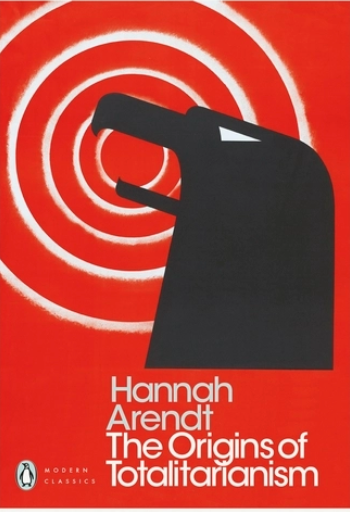
It is a great tragedy that few have recognised one of the most important insights into the nature of anti-Semitism. Back in 1951 The Origins of Totalitarianism by Hannah Arendt, perhaps the greatest political theorist of the 20th century, described anti-Semitism as “an outrage to common sense”. If only her argument was probed further it would become clear that anti-Semitism is far worse than hatred of Jews alone.
The challenge is to find out how Jews have come to be seen by some as epitomising the supposed evils of modernity and western civilisation. In the time Arendt was covering the focus was on Jews themselves as personifying evil. More recently Israel, the Jewish state, has come to be seen by a significant number as embodying the evils of the modern world. This is a trend which was also recognised recently by Matti Friedman, a Canadian-Israeli journalist in what he called Gazology. Anyone who doubts that anti-Zionists view Israel as central to the world’s evils would do well to examine the diagram below (with the rest of this article below that):

Anti-Semitism, including in its anti-Zionist form, has an important symbolic dimension. That is not to suggest that it is unreal. On the contrary, it is the symbolic character of anti-Semitism, with Jews cast as epitomising evil, which makes it so dangerous.
Arendt’s book aimed to explain how the Jewish question, relatively small on a global scale, sparked the great tragedies of the 20th century. Nazism, the second world war and the Holocaust were all somehow driven by anti-Semitism.
As Arendt put it in her preface: “the Jewish question and anti-Semitism, relatively unimportant phenomena in terms of world politics, became the catalytic agent first for the rise of the Nazi movement and the establishment of the organizational structure of the Third Reich, in which every citizen had to prove he was not a Jew, then for the world war of unparalleled ferocity, and finally for the emergence of the unprecedented crime of genocide in the midst of Occidental civilization” (pxvii, original emphasis). She went to on note that “This book is an attempt to understanding what at first and even second glance appeared simply outrageous” (pxvii).
Her description of anti-Semitism as a “catalyst” helps clarify the argument. Although the Jewish population, even before the Holocaust, accounted for a relatively small part of Europe’s population the phenomenon of anti-Semitism somehow precipitated vast change.
Arendt’s explanation of anti-Semitism is relatively complex but it is relatively easy to outline what she says it is not. These points still have resonance today. First, she says it is not merely the hatred of Jews just as imperialism is not merely conquest and totalitarianism is not merely dictatorship (pxi). Second, she argues that anti-Semitism should not be seen as the outcome of rampant nationalism and xenophobia. As it happens the Nazis were opposed to what they saw as narrow nationalism. Often they embraced a pan-German ideology which saw them as representing ethnic Germans who were then widely scattered across Europe. Third, she argues against the idea that anti-Semitism can be explained by the idea of Jews as scapegoats. For this fails to account for why the Jews specifically become identified as the source of global evil. Finally, she argues against the notion of eternal anti-Semitism. For Arendt anti-Semitism, as a racial ideology, emerged in the 19th century. It was a reaction to a period of emancipation in which Jews were finally allowed to leave their ghettoes and become integrated into wider society. That made it fundamentally different from the old religious hatred which preceded it. That was essentially a form of religious animosity rather than an expression of racial thinking.
A lot has changed in the decades since Arendt wrote Origins but these superficial explanations for anti-Semitism live on to this day. Anti-Semitism is cast as a hate movement – with little understanding of its broader symbolic significance. Anti-Semitism is blamed on rampant nationalism – without regard to the fact that anti-Semites are often avid anti-nationalists. Both the woke and Islamists in different ways fall into this anti-national category. Jews are held up as scapegoats – without explaining why Jews in particular are so often chosen as embodying evil. Anti-Semitism is held to be the “oldest hatred” – with little regard to what is specific about today’s conditions.
Arendt gives several reasons for the hostile focus on the Jews in the period she was covering. Jews became associated with the forces of modernity which were viewed by many as destabilising if not malign.
The emancipation of Europe’s Jews, allowing them to move from society’s margins, in the 19th century helped prompt a hostile counter-reaction. The association of Jews with finance also meant that any financial turmoil could easily prompt an anti-Semitic reaction (she gives the example of a scandal over the financing of the Panama Canal acting as a prelude to the notorious Dreyfus case in France ). Finally, the disintegration of the European system of nation-states in the first world war and its aftermath somehow became associated with the Jews. The Nazis, for example, blamed the Jews for Germany’s defeat in the first world war.
Under these circumstances what Arendt calls the declassés, those who had lost social standing, could easily turn into a “modern mob” against the Jews. As Arendt argues this group “produced leaders who, undisturbed by the question of whether Jews were sufficiently important to be made the focus on political ideology, repeatedly saw in them the ‘key to history’ and the central cause of all evils” (p12).
Decades later global politics has changed fundamentally but, particularly since the turn of the millennium, anti-Semitism has surged. Most often it takes an anti-Zionist form, with the focus on the supposed evils of the state of Israel, although older tropes are often resurrected. Since the pogrom of 7 October 2023 the problem has become even more pronounced.
This website has often rehearsed the contemporary drivers of anti-Semitism. Once again Jews are often associated with modernity at a time when modernity itself is often viewed with loathing. The mood of deep cultural pessimism following the end of the Cold War in the late 1980s has played a key role in driving this trend. Identity politics has come to the fore – with the underlying assumption it is no longer possible to transcend social divisions – with Jews often viewed as hyper-privileged whites.
In this context Israel is cast as the worst example of white supremacy. It is seen as a colonial-settler state embodying the evils of colonialism seen, at least in this world view, as rampant in the West too.
Israel is also viewed with particular loathing as it is seen as an example by many of the dangers of nation-states. As I have written recently Israel is viewed with hostility by anti-populist elites who are implacably hostile to notions of self-determination and national sovereignty.
Finally, there is the trend which first emerged in poorer countries themselves. The Islamist movement, also hostile to modernity and national self-determination, which has long seen Israel as a Satanic force. Its outlook is heavily influenced by The Protocols of the Elders of Zion, a notorious anti-Semitic forgery, which Arendt wrote about in her own time. Islamism in turn meshes with contemporary western anti-Semitism to give it added impetus.
All of this remains, as in Arendt’s time, difficult to explain by most normal standards. Jews account for about 15 million people globally out of a world population of over 8 billion. Israel itself has a Jewish population of only about 7 million – so less than one in a thousand of the global total. Yet the Jewish state consumes a huge amount of attention as a supposedly demonic force in the world.
It is truly an outrage to common sense.
All page numbers are references to the 2017 Penguin Classics edition of The Origins of Totalitarianism.
Further reading : Stefanie Borkum Hannah Arendt on a dangerous fallacy
PS – This recent article from the Tablet, an American magazine focused on Jewish news and culture, on The Joy of Hating Jews in some respects complements Arendt’s analysis. For example, anti-Semites can feel their conspiracy theories about Jewish power give them a privileged insight into the state of the world. They can also see their anti-Semitism is an expression of virtue.