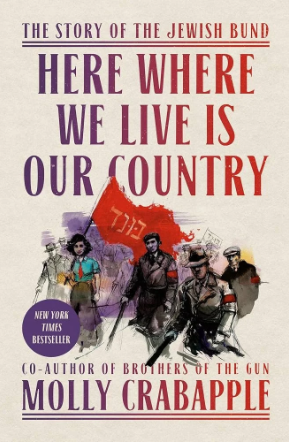
The publication of Here Where We Live Is Our Country marks the opening of a new front in the multi-pronged propaganda war against Israel. Its goal is to use the Jewish Labour Bund’s history - once an influential force in eastern Europe’s then substantial Jewish community - against Israel. The conclusion it draws is that Zionism is not only bad for Palestinians but also for Jews. Unfortunately for the author the Bund’s history shows the opposite of what she claims.
The New York Times bestseller by Molly Crabapple, an American visual artist and writer, should be read in that light. It declares itself loudly as a book against Zionism and for the Palestinians even though its subject is ostensibly the Bund. She sets the tone in the introduction. Although she acknowledges that Nazi Germany and the Soviet Union obliterated the Bund she nevertheless blames Zionism for its absence from current consciousness.
Crabapple also has the disconcerting habit of shifting between eastern European history and events elsewhere in the present. For example, in her chapter on the Nazi invasion of Poland she inserts a section on Gaza. She also switches at one point from the 1905 mass uprising in Russia to the response to the police murder of George Floyd in Minneapolis in 2020.
Indeed although the book is supposedly about the Bund it is explicitly framed around her personal predilections and social justice politics. The project started when the New York Review of Books published an article by her about her great-grandfather. Samuel Rothbart started as a Bundist leatherworker in Volkovysk, now in Belarus, before eventually becoming an artist in New York City. The book itself is mainly written around different key personalities in the history of the Bund and different places where they operated. This sometimes makes for a compelling story but it obscures the broader drivers in the Bund’s history.
The narrative is also marred by a framework which sees the world neatly divided into the oppressed and the oppressors. In her telling Bundists were internationalists unequivocally on the side of good while Zionists, as nationalists, were almost always on the side of evil. The latter was particularly true from 1948 onwards when, she argues, Israel was established as an oppressive ethno-state.
None of this is to deny that the Bund was once an important part of Jewish life in the early 20th century. It was a socialist movement which grew up in what was then the predominantly Yiddish-speaking heartland of Jewish life worldwide. Millions of Jews were living in the Russian Empire including a significant intelligentsia and a working class who were mainly artisans and small workshop employees.
This was the same milieu in which Zionism also emerged. The Bund was founded in 1897 in Vilna (now Vilnius in Lithuania), the same year as the first Zionist Congress in Basel, Switzerland. But despite the location of the Zionist congress much of the support for Zionism came from eastern Europe.
The key political difference between the two was that the Bund advocated socialist revolution whereas the Zionists favoured a Jewish state. Crabapple makes much of the Bundist concept of doikayt – Yiddish for “hereness” – which emphasised transforming social conditions wherever Jews lived.
For most of the period under discussion the Bundists outnumbered the Zionists but history did not treat the Bund kindly. After the 1917 revolution some of the Bundists were merged into the ruling Communist Party. Those who refused to do so were repressed and eventually liquidated. Then in 1939-41, when the Soviet Union invaded the eastern regions of eastern Europe, many of the remaining Bundists in the areas were rounded up and imprisoned.
When the Nazis moved into eastern Europe, including Poland, they ended up slaughtering millions of Jews. These included not only Bundist party members but most of the party’s social base of eastern European Jewry.
With the considerable benefit of hindsight it should be clear that – tragically in a way – the Zionists turned out to be right. Those who saw the future as transforming European society ended up being murdered by Nazi extermination squads and in the death camps. The Bund as an organisation was destroyed by the twin forces of Nazism and Stalinism. Under these circumstances it is hardly surprising that most Jews came to see Zionism – having a state of their own – as a more realistic option.
Zvi Gitelman, a genuine authority on the Bund, gave four reasons why the Bund became defunct. First, the simple answer is that its supporters were mostly murdered. However, this was also true of Orthodox Jews and Zionists living in the area. Second, the assumption that socialist states would solve “the Jewish problem”, as well as other ethnic problems, was contradicted by the abysmal record of such states. Third, after the Holocaust there was no longer a substantial Jewish proletariat. Finally, Yiddish, previously the dominant language among eastern European Jews, was no longer widely spoken after the Holocaust (except among the Haredim, ultra-Orthodox). Millions of its native speakers were killed while it gradually dwindled in countries to which Jews migrated.
But none of this matters to Crabapple or the many anti-Israel activists citing the book to strengthen their case. Their goal is not to present a balanced history of the Bund – an important chapter in Jewish political history – but simply to provide a one-sided account that can be used to bash Israel.
*For those who want to read a more balanced treatment of the Bund there is the entry in the Yivo Encyclopedia. It contains references to further academic texts but these are often expensive and difficult to obtain.
Molly Crabapple Here Where We Live Is Our Country: The story of the Jewish Bund. Bloomsbury 2026.