
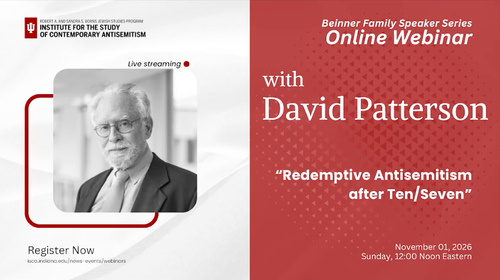
It is exceedingly rare for anyone to say anything new about the nature of anti-Semitism. Almost invariably the argument is couched in terms of tired formulas such as “the oldest hatred” or “a conspiracy theory”. So David Patterson’s recent characterisation of the Hamas-led pogrom of 7 October 2023 and its aftermath as a form of “redemptive anti-Semitism” should be welcomed (see video of webinar below). It helps to explain the nature of the current threat.
Before outlining the concept a quick note on the traditional but inadequate alternatives. Anti-Semites do, of course, hate Jews. But, as I have argued previously on this site, the animosity towards Jews is insufficient even as a description. There are lots of groups which are the subject of hatred but anti-Semitism has a particularly pernicious power. It is also true that anti-Semitism has a conspiracy theory at its heart. But it is necessary to go further to explain why Jews specifically are so often at the centre of such theories.
For me the heart of the anti-Semitic mindset is the view that Jews embody the perceived evils of the modern world. Anti-Semitism is not an inherited ancient belief but, on the contrary, a reaction against modernity. Classical anti-Semitism, from the 19th century onwards, typically focused on the perception of Jews as personifying the evils of speculative finance. In its contemporary anti-Zionist form it poses Israel, the Jewish state, as embodying the evils of apartheid, colonialism and genocide. It is essentially a reaction against the West with Israel seen as representing the worst that western civilisation has to offer.
This brings us back to the characterisation by David Patterson, a professor at the University of Texas at Dallas, of redemptive anti-Semitism. The way he poses the argument is that its “premise is not that all Jews are evil but that all evil is Jewish”. In other words the world’s evils are seen by redemptive anti-Semites as having a Jewish character. Their conclusion is an annihilationist one: “Purging evil from the world requires purging Jews from the world”.
This view informs Hamas’s atrocities. For the Islamist terrorist group the murder of Jews was not a regrettable necessity but, on the contrary, an act of piety. That was evident on 7 October itself when Hamas livestreamed its brutality for the whole world to see. It was, in its twisted view, a cause for rejoicing.
It also informs the worldview of anti-Israel activists although they are often more coy about admitting it openly. It is nevertheless true that for them redemption means supporting the elimination of the Jewish state. In their view being a virtuous person means campaigning for the end of Israel “from the river to the sea”.
Patterson’s innovation was applying the concept of redemptive anti-Semitism to the contemporary world but he did not invent it. He credits Saul Friedländer, one of the greatest of Holocaust scholars, with developing the concept in relation to Nazi Germany.
Chapter three of Friedländer’s masterpiece on Nazi Germany & The Jews outlines the idea. For him redemptive anti-Semitism became the dominant aspect of a broader anti-Semitic worldview. It was, he argues, particularly prevalent among Hitler and his circle. In his words for the Nazi elite: “Redemption would come as liberation from the Jews – as their expulsion possibly their annihilation”.
Many elements outlined by Friedländer are recognisable in anti-Semitism in its contemporary anti-Zionist form. For example, the Jew, or in the contemporary view the Jewish state, is seen as both superhuman and sub-human. Jews are perceived as superhuman in that they are supposedly driving the world to eternal damnation. They are also sub-human in that they are allegedly a cause of infection, disintegration and death.
The general public are also typically viewed with disdain by the anti-Semites. They are seen as a hypnotised mass of people at the mercy of a Jewish conspiracy. This view is echoed in the current discussion of the Israel lobby in America somehow pushing the country to disaster.
Developing an accurate description of the mindset of redemptive anti-Semitism is important but it is only a first step. Ultimately the goal should be to explain the driving forces behind it.
This task is beyond the scope of the article but having an accurate take on the outlook gives two important clues.
First, it appeals to those who see the world in black-and-white terms. Those who cannot see shades of grey, but just see a simple binary between good and evil, are likely to find redemptive anti-Semitism appealing. It allows them to define themselves as on the side of good and against evil.
Second, anti-Semitism is best seen as a reaction against modernity. It emerged as a racial ideology in reaction to the emancipation of Jews from the 19th century onwards. The anti-Semites reacted against Jews moving from the margins of European society to becoming more integrated. In their minds Jews became associated with the broader process of social modernisation. In relation to Israel it has become associated with the ostensibly malign influence of the West on the world as a whole.
Identifying the ideology of redemptive anti-Semitism does not provide all the answers but it is an important starting point. It helps explain not only backward attitudes to Jews but the widespread antipathy to western civilisation.
*David Patterson’s webinar on redemptive anti-Semitism, organised by the Institute for the Study of Contemporary Antisemitism (ISCA) at Indiana University, can be viewed below:
*His latest book examines the subject in more detail. David Patterson. Redemptive Antisemitism after Ten/Seven. ISGAP. 2026
Further reading
More articles can be found on this site's anti-Semitism THEME.